
Coinkite COLDCARD postmortem: Yasmarang RNG, 1,778.84 BTC from 8,600+ addresses
Coinkite's 23 November postmortem says COLDCARD firmware from 29 March 2021 through 30 July 2026 made seeds with MicroPython's Yasmarang PRNG, not the STM32 hardware RNG. Galaxy Research, on 14 August, counted 1,778.84 BTC taken from more than 8,600 addresses.

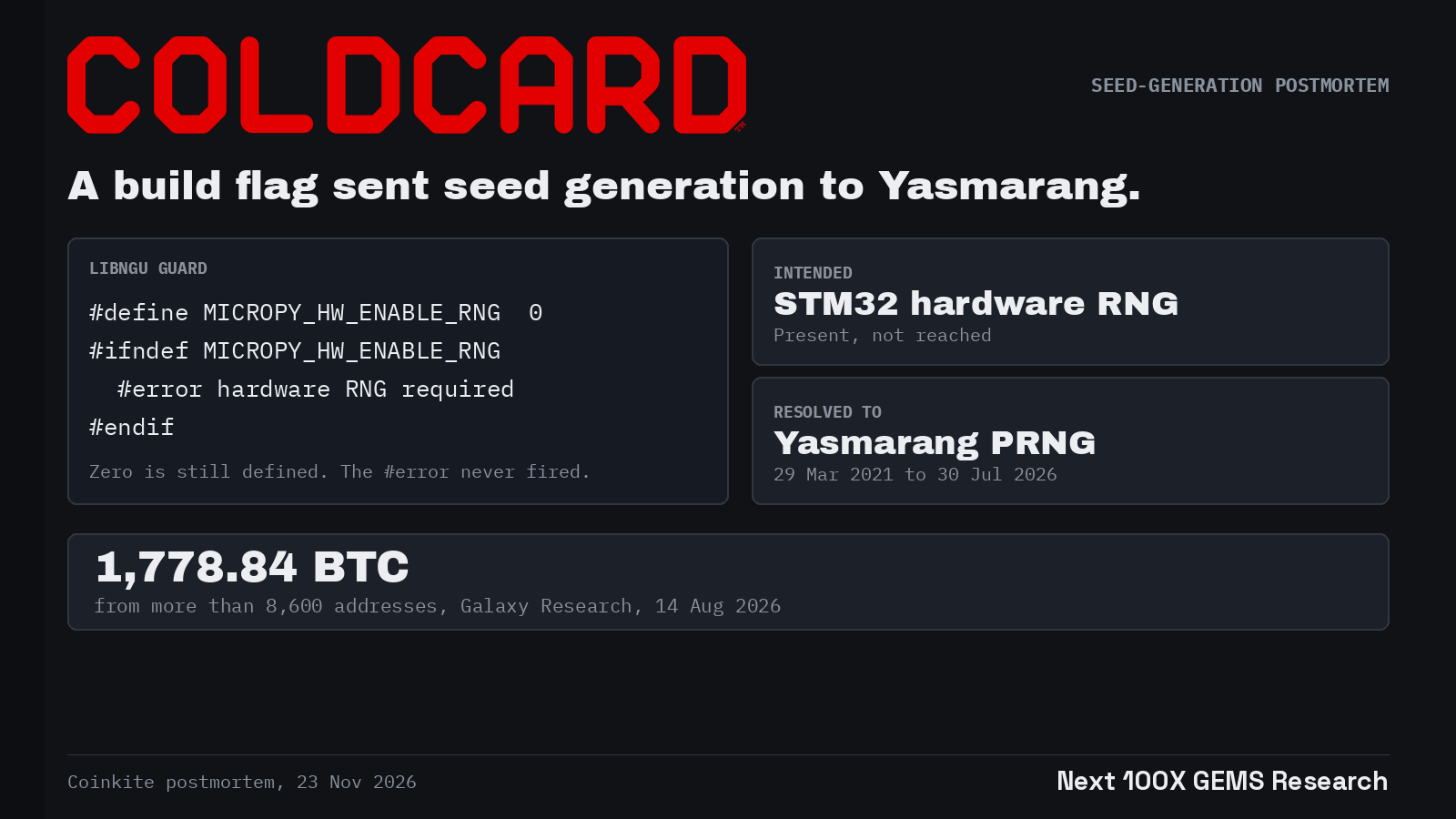
The thefts started on 29 July 2026. Nobody had to touch a COLDCARD. Attackers rebuilt private keys for seeds the devices had already made, then swept the coins. On 14 August 2026, Galaxy Research said it had confirmed, with high confidence and after speaking with 190 people who reported losses, that 1,778.84 BTC had been taken from more than 8,600 addresses. That count left out lower-confidence sets, including an unconfirmed "Wave 4." If those had been included, Galaxy's figure would have been 2,417.35 BTC.
Coinkite's postmortem, dated 23 November 2026, cites Galaxy's address count as 8,865 as of 24 August, and says no public total of users or losses across every wave has been established. As of 18 November, the company had 300 loss-related support tickets tied to 242 accounts, about 0.21% of its estimated user base, a share it says is likely low because not every victim files a ticket.
The devices were never entered. The seeds were weak.
A zero that counted as a yes
From 29 March 2021 through 30 July 2026, COLDCARD firmware generated wallet seeds with MicroPython's Yasmarang software pseudo-random number generator instead of the device's STM32 hardware random-number generator. That window is Coinkite's.
The design was supposed to have no software fallback. In March 2021, when seed generation moved through a library called libNgU, the firmware set MICROPY_HW_ENABLE_RNG to 0, meaning to switch the software path off. A guard in the pinned libNgU code used #ifndef, which only asks whether the macro is defined, not whether its value is nonzero. Zero still counts as defined. The build passed. libNgU's rng_get() resolved to Yasmarang. The hardware generator sat in the binary and was never reached by seed generation. The device still produced well-formed seed words.
Coinkite calls this a COLDCARD integration defect, not a bug in libNgU itself, and not a runtime failure of the hardware RNG. Attackers did not need physical access. They regenerated keys offline.
Coinkite estimates the affected seeds had roughly 40 bits of effective entropy on Mk2 and Mk3, and roughly 72 bits on Mk4, Mk5 and Q, against a 128-bit security target. The 72-bit figure, the postmortem says, has not been independently established. Block's Bitcoin Engineering and Security teams, in a 30 July write-up, described a further constraint on the later models: boot mixed in secure-element entropy, then a reseed replaced only one 32-bit Yasmarang state word, leaving at most 2^32 securely distinguished output streams once the fallback state and call history were fixed. Hashing the output, both Coinkite and Block say, could not add entropy that was not there.
The ranges Coinkite published
The 23 November report lists the affected firmware by model and track, and the first fixed release for each. For Mk2 and Mk3, seeds generated on 4.0.1 through 4.1.9 are affected; the minimum fixed release is 4.2.0 or later. For Mk4 and Mk5 on the standard track, the affected range is any seed generated before 5.6.0, with 5.6.0 or later as the fix. On the Mk4 and Mk5 Edge track, the cut is before 6.6.0X, fixed in 6.6.0X or later. For Q on the standard track, the affected range is before 1.5.0Q, fixed in 1.5.0Q or later; on the Q Edge track, before 6.6.0QX, fixed in 6.6.0QX or later. Standard and Edge are separate tracks with independent version numbers. As of the report, the current standard releases were 5.6.3 and 1.5.3Q, and the current Edge releases were 6.6.2X and 6.6.2QX.
v4.0.0, which is visible in the source lineage, was not distributed as a signed public binary. The first signed public release in the series was 4.0.1, on 29 March 2021.
A seed generated on affected firmware stays affected after it is restored, imported, backed up or cloned. A seed that was securely generated outside that on-device flow was not weakened by later import into an affected device. Seeds made with at least 50 fair, independent, private dice rolls entered through Add Dice Rolls, with the sequence never recorded or exposed and the final post-roll words used, "were not weakened by the defect," the report says. A strong BIP-39 passphrase or a multisig setup, Coinkite says, added a barrier the weak seed did not; those layers do not repair the seed itself.
Coinkite identified the defect on 30 July and published fixed firmware for all supported tracks on 31 July. Keylabs, in a review published 15 October, concluded that, within its stated scope, the defect is fully closed in Mk5 5.6.3 and 5.6.2 and in Q 1.5.3Q and 1.5.2Q. Edge releases were outside that review.
Between 2021 and 2026, Coinkite documented at least 15 independent review and security-research efforts on COLDCARD hardware, firmware, entropy tooling and release controls, including two commissioned third-party product reviews. The scopes varied, and not all of the work examined seed generation. A 17 June 2026 review by Nick Farrow expressly included weak RNG in its scope, concluded the path was sound, and did not find the defect. No contemporaneous report, Coinkite says, identified and reproduced the build-integration error.
What Coinkite tells owners
The company points owners to sections 1.4 and 4.1 of the report, and to the Security Status page at coldcard.com/security/status, to check whether they are affected and what to do. A firmware update, it says, does not repair a seed generated on affected firmware.
If a seed was generated on affected firmware, Coinkite's user recommendations are to install verified fixed firmware, create a new seed, verify it and its backup, and move the funds, including from passphrase wallets. Never send seed words, passphrases, dice rolls, private keys, backup files or backup passwords to anyone, including Coinkite, or enter them into any website. Use only support routes linked from coldcard.com, and treat unsolicited recovery, migration or compensation offers as likely impersonation.
A recommendation to decide on and publish any compensation or assistance plan for affected customers remains open, with no decision recorded in the report.
TAPSIGNER, OPENDIME and SATSCARD, Coinkite has said, are not affected, because they use different codebases.
Sources
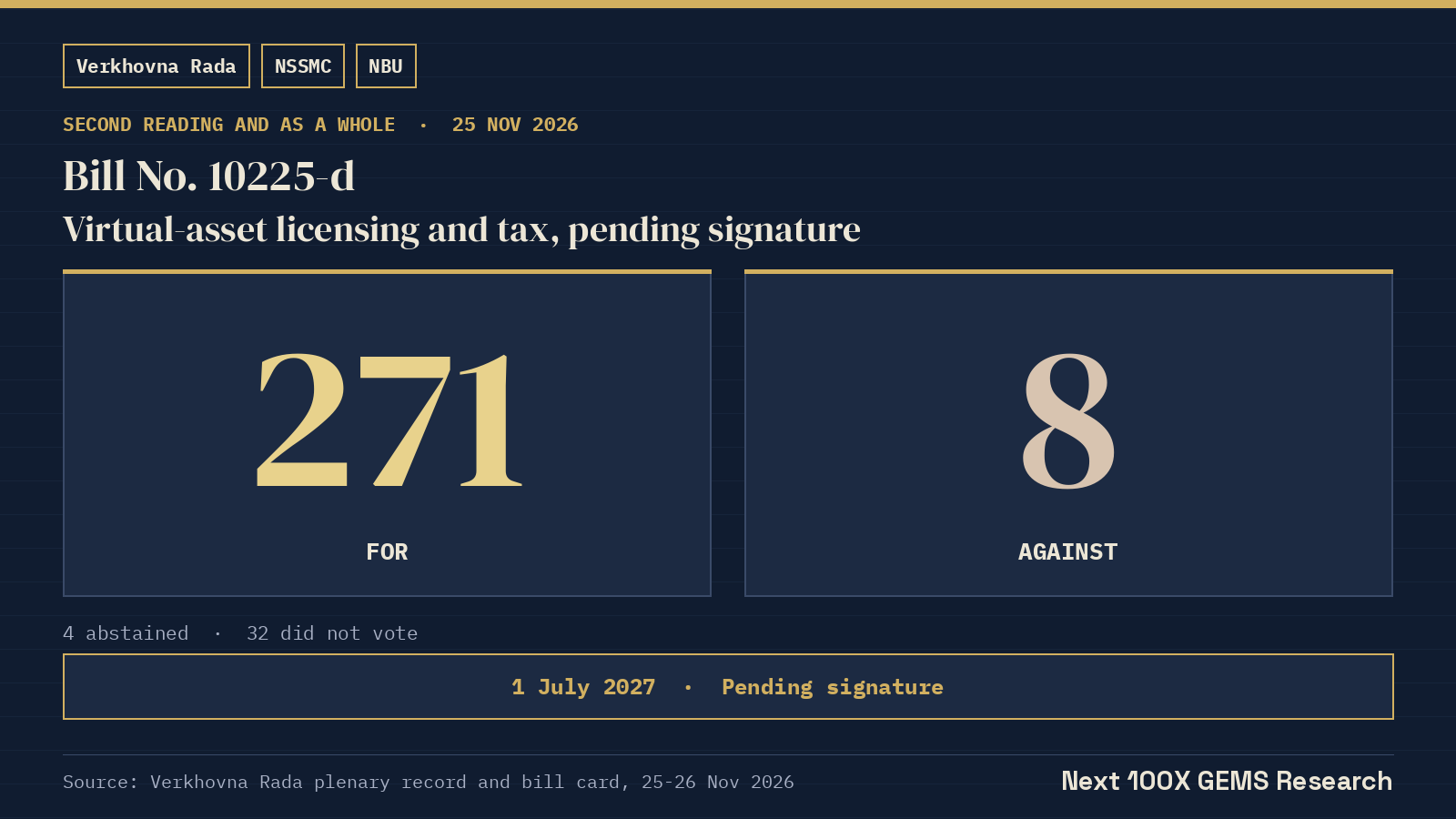
Coinkite, "COLDCARD Seed-Generation Incident Postmortem," 23 Nov 2026 Coinkite, "Our COLDCARD seed-generation postmortem is now public," 24 Nov 2026 Coinkite, "Technical Deep Dive into the Entropy Issue" Block Engineering, "Predictable RNG Fallback and 32-Bit Reseed in COLDCARD Firmware," 30 Jul 2026 Galaxy Research, "Coldcard Exploit Abates as Total Losses Climb to (at Least) 1,700 BTC," 14 Aug 2026 Coinkite, "Adding to the Public Record on Our Ongoing Investigation"
Next 100X GEMS Research
A crypto community active since 2021, focused on helping newcomers spot scams and understand the market.
How we work