
Lighter API key leak: how a reused nonce gave away a trader's private key
Nobody broke into Lighter on 16 November. A trader's own signing code reused nonces, and that was enough for anyone to work out the API key from public signatures. Here is the maths in plain words, the route the money took and what Lighter changed.

How do you steal a key that nobody leaked? That's the real question behind the Lighter API key leak of 16 November. Lighter, the Ethereum-based perpetual futures exchange, says its smart contracts and official software were never touched. A trader's own signing code reused nonces, and that one habit let an outsider calculate the account's private API key from signatures anyone could read.
The short version: a digital signature hides the key behind a one-off random number. Use that number twice and the hiding stops working. The rest of this piece walks through why, then follows the money and the fixes.
Step one: what a signature is hiding
Every action on Lighter is approved by a signature from an API key, Lighter's postmortem explains. Each signature blends the private key, which never leaves the trader's machine, with the message being signed. A fresh random number goes in too, called a nonce, short for "number used once." The signature itself is public.
You can picture a simplified signature as one line of school algebra:
s = k + e × x
Here x is the private key and k is the nonce. Both are secret. The value e is computed from the message, so anyone can work it out, and s is the signature everyone sees. One equation with two unknowns can't be solved. As long as k is new and unpredictable each time, an onlooker learns nothing useful about x.
Step two: what happens when the nonce repeats
Now sign a second, different message with the same nonce:
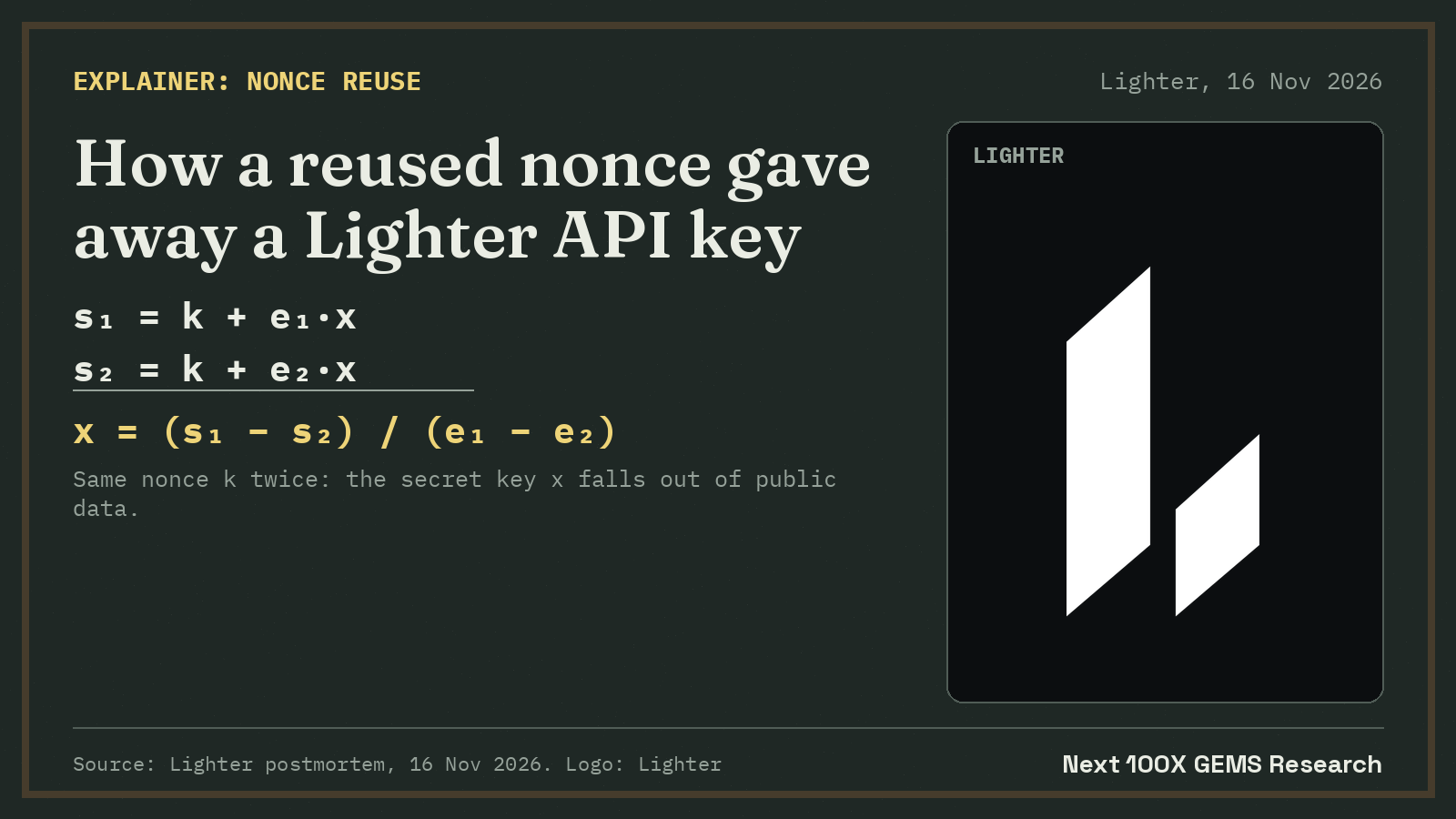
s₁ = k + e₁ × x s₂ = k + e₂ × x
Subtract one line from the other and k cancels out. What's left is s₁ minus s₂ equals (e₁ minus e₂) times x. Every value in that line except x is public, so x falls out with one division. That's the whole attack. Nobody had to guess a password or get inside a server.
Lighter's postmortem puts it the same way: if the same nonce is used with the same key on two different transactions, "anyone can calculate the private key from those two signatures." The postmortem doesn't say which exact signature scheme its API keys use, so take the line above as the textbook form. It also notes the problem isn't specific to Lighter and applies to Bitcoin and Ethereum signatures too. Their scheme, ECDSA, has a longer formula, but the same two-equation trick works on it.
Bad randomness has bitten crypto before. A bitcoin.org alert dated 11 August 2013 warned that a weakness in how Android generated secure random numbers left every Bitcoin wallet created on Android up to that point open to theft.
Step three: turning a key into a withdrawal
A recovered API key still can't withdraw to someone else's wallet. Lighter says withdrawals only go to the account owner's own wallet. So the attacker took a side door. An API key could send funds to its account's sub-accounts, and a public pool created by the account counted as one.
According to the postmortem, the attacker used the leaked key to create a public pool from the trader's account, minted pool shares in a separate account they controlled, moved the trader's funds into the pool without minting new shares, and then redeemed their own shares and withdrew. Every share they held had become worth far more.
How much left is disputed. Bitquery traced a withdrawal of $10.39 million in USDC from Lighter's Ethereum contract, swapped for ether within minutes, CoinDesk reported on 16 November. Bitquery said 1,920 ETH, about $3.5 million, then moved through 12 wallets to Hyperliquid. On-chain analysts Lookonchain and Onchain Lens put losses at $15.5 million, The Block reported on 17 November, and CoinDesk said that higher figure covers two market-maker accounts. Lighter hasn't confirmed either number or given a total of its own.
Some money did come back. Lighter says the anomaly triggered its smart contract Guardian, which paused withdrawals and let the Lighter Security Council return about 5 million USDC to the affected trader. Withdrawals were running again by the end of 16 November, per The Block. CoinDesk reported that Lighter's LIT token fell more than 10% to under $2.48 that day before climbing back to $2.62.
What Lighter changed
Two fixes are already live, the postmortem says. Moving funds into a public pool now needs a wallet signature, so an API key alone can't do it. And API key signatures are no longer public, which takes away the raw material for this kind of maths.
More is on the way. Lighter is adding IP allowlists, so a key only works from a server you choose, along with permissions and limits you can set per key for actions and markets. It's also watching signatures for reused nonces and says it will contact affected accounts and void their keys.
The same habit, on any venue
The lesson reaches past Lighter. Anyone who runs trading code on any venue is making the same bet on how their nonces are chosen.
Lighter says its official software kits draw every nonce from a cryptographically secure random number generator. It warns against deriving a nonce from a timestamp, a counter, a weakly seeded generator, the transaction's contents or a cached value. If you can't show a nonce never repeated, Lighter's advice is to rotate every API key and switch to an official kit.
A stolen key can still do damage even when it can't withdraw. Lighter points out that a key that can trade can trade against you in thin markets or pile risky leverage onto your account. Tight permissions limit that damage.
The algebra is easy, and the expensive mistake was in the plumbing around it. The trader's key was never stored anywhere an attacker could reach. It was sitting in plain sight, one repeated number away.
Sources
- Lighter, "Signing Safely on Lighter: Lessons from November 16" (16 Nov 2026): https://x.com/i/article/2122382079644041216
- The Block, "Lighter reopens withdrawals after trader's API key leak, returns about $5 million in USDC" (17 Nov 2026): https://www.theblock.co/news/defi/2026-11-17-lighter-reopens-withdrawals-after-traders-api-key-leak-returns-about-5-million-in-usdc-442113
- CoinDesk, "Lighter suspends all withdrawals after $10.4 million crypto exploit" (16 Nov 2026): https://www.coindesk.com/tech/2026/11/16/lighter-suspends-all-withdrawals-after-usd10-4-million-crypto-exploit
- Bitcoin.org, "Android Security Vulnerability" (11 Aug 2013): https://bitcoin.org/en/alert/2013-08-11-android
Next 100X GEMS Research
A crypto community active since 2021, focused on helping newcomers spot scams and understand the market.
How we work