The DEATH BETS Act passed the Senate: what Kalshi and Polymarket couldn't list anymore
S.4035 cleared the Senate by voice vote on 19 November. It would stop CFTC-registered exchanges from listing contracts that expressly reference terrorism, assassination, war or US military operations, or that turn on someone's death. It isn't law yet. Here is what the text actually says.

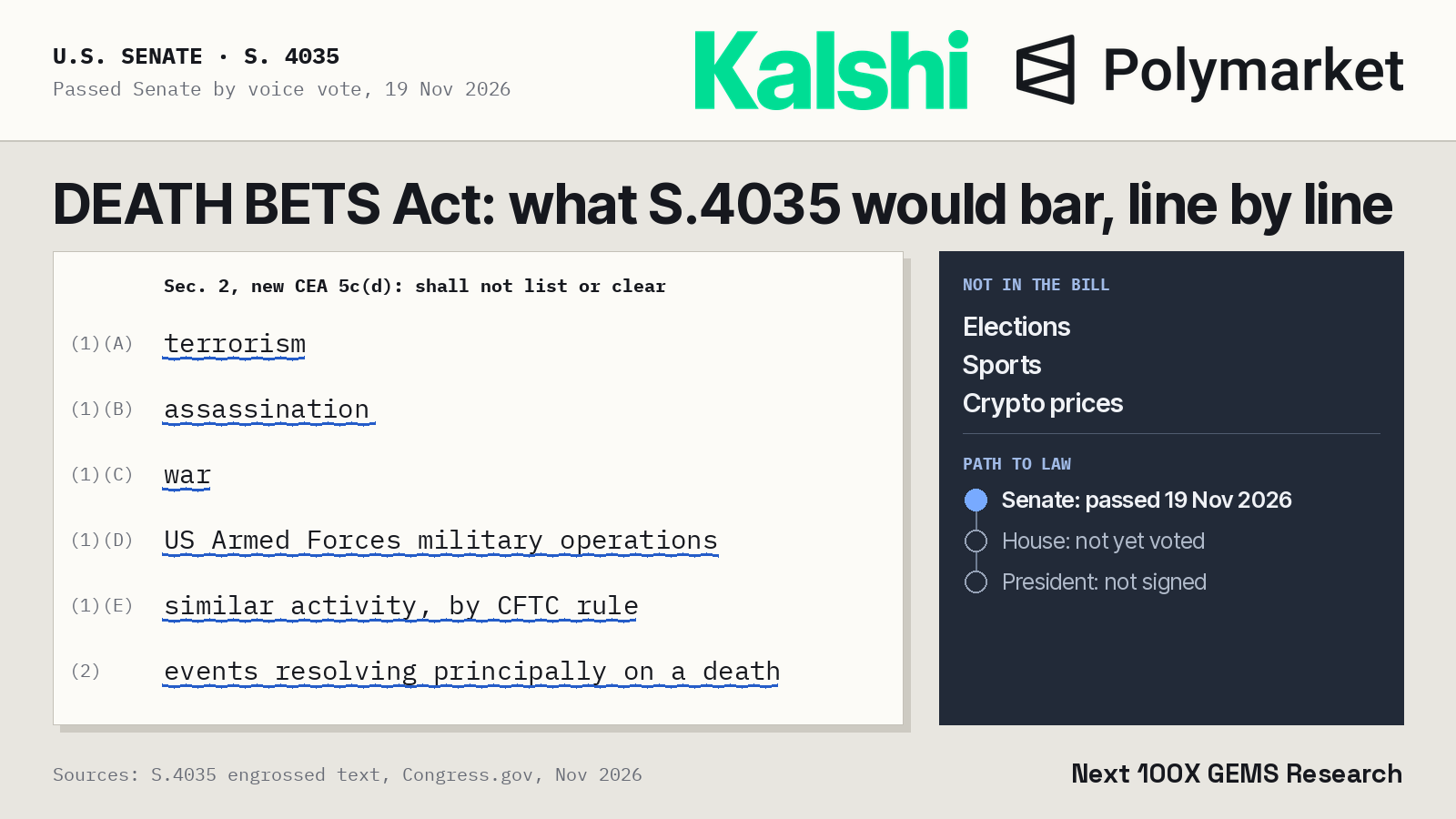
On 19 November 2026 the Senate passed S.4035, the DEATH BETS Act, by voice vote, after adopting a substitute amendment from Sens. Adam Schiff and John Curtis by unanimous consent. The engrossed text is one page long. It would bar any CFTC-registered exchange or clearinghouse from listing or clearing event contracts that expressly reference terrorism, assassination, war or US Armed Forces military operations, plus any contract that, when listed, is "reasonably expected to resolve principally based on a death of an individual." Elections, sports and crypto prices aren't on the list. And none of this is law. The House still has to pass it, and the President still has to sign it.
The lines that matter
The bill adds a new subsection (d) to section 5c of the Commodity Exchange Act. It opens like this:
"A registered entity shall not list for trading or accept for clearing on or through the registered entity any of the following"
"Registered entity" means the exchanges and clearinghouses the CFTC oversees. Kalshi is one. So is Polymarket US, run by QCX LLC, which the CFTC designated as a contract market on 9 July 2025. Polymarket's international site isn't registered with the CFTC, and nothing in this bill reaches it. "Shall not" matters too. Current law says only that the CFTC "may determine" contracts involving terrorism, assassination, war or gaming to be against the public interest. Schiff's office put the point bluntly: whether to block them is now "at the discretion of the CFTC," and the bill takes that discretion away.
Next comes the scope:
"An agreement, contract, transaction, or swap based on an excluded commodity described in section 1a(19)(iv) that expressly references"
Section 1a(19)(iv) is the law's definition of an event contract: an "occurrence, extent of an occurrence, or contingency" beyond the parties' control, "other than a change in the price" of most commodities. That carve-out is why a contract on where bitcoin closes isn't touched. It's a price contract, not an event contract under this clause.
The word "expressly" is new. The bill as introduced on 10 March covered any contract that "involves, relates to, or references" the banned topics. The amended version only catches contracts that name them. Then comes the list:
"(A) terrorism; (B) assassination; (C) war; (D) United States Armed Forces military operations; or (E) any similar activity, as determined by the Commission pursuant to rule or regulation"
Item (D) wasn't in the original bill. Item (E) lets the CFTC add topics, but only by rule.
The death clause comes last:
"for which the event for the contract, at the time of listing, is reasonably expected to resolve principally based on a death of an individual."
The original version covered any contract that "could otherwise be construed as correlating closely to an individual's death." The new test is narrower and fixed in time: what a reasonable person would expect when the contract is listed, not what happens later.
Section 3 is the rule of construction Curtis described as the reason for the substitute. It says nothing in the act changes the legal status of other contracts in the existing public-interest list, such as gaming or unlawful activity. In Curtis's words, the amendment makes sure the bill "does not change existing law governing other event contracts, including those involving gaming broadly." The sports-contract fight, in other words, is left exactly where it was.
Which markets this is about
The senators named examples, but not all of them would be covered. On the floor, Schiff cited a market on whether the Artemis II mission would explode, one on whether Nicolás Maduro would be removed from power, and one on whether Russia would capture the Ukrainian town of Myrnohrad. His own press release describes these as offered "on offshore exchanges." Legal Sports Report placed the $400,000 Maduro trade on Polymarket's international platform. Being offshore, those venues sit outside the bill.
The case that touches a US-registered venue is Kalshi's market on whether Iran's Supreme Leader Ali Khamenei would leave office. Fortune and Legal Sports Report both reported a settlement dispute after his death, because Kalshi's rules excluded death as a qualifying outcome. Whether a market like that would count as "reasonably expected to resolve principally" on a death is exactly the kind of question the new wording leaves to the CFTC and the courts. No one has said how it would apply.
Kalshi CEO Tarek Mansour wrote on X in February, "We don't list markets directly tied to death," Fortune reported. Neither Kalshi nor Polymarket responded to Fortune's request for comment on the vote, and we found no statement from either company as of 21 November.
Why now
Schiff's office pointed to reports this year of suspected insider trading on war and military actions. "Betting on war and death jeopardizes our national security by creating a perverse environment in which violence is incentivized and insiders are allowed to profit off privileged or classified information," Schiff said. His release also cited CFTC Chair Selig's stated plan to rewrite the prediction market rules as a reason not to leave the matter to the agency. Bloomberg Law noted the CFTC already "generally restricts contracts tied to war," and the bill would turn that into a statutory ban that also covers deaths. For background on what a CFTC designation lets an exchange do, see our explainer on Backpack's CFTC approval.
The path from here
A Senate pass is one step out of three. Rep. Mike Levin has introduced a companion bill in the House, according to Schiff's office. The House would have to pass the same text, and the President would have to sign it, before any of this binds an exchange. Legal Sports Report notes the House must act before the current Congress adjourns in January. If it doesn't, the bill dies and would have to be reintroduced.
Separately, Schiff and Curtis have filed the Prediction Markets Are Gambling Act, which would go after sports and casino-style contracts. That one hasn't passed anything.
Sources
- S.4035, engrossed in Senate (text as passed), 19 Nov 2026: https://www.govinfo.gov/content/pkg/BILLS-119s4035es/html/BILLS-119s4035es.htm
- S.4035, introduced in Senate, 10 Mar 2026: https://www.govinfo.gov/content/pkg/BILLS-119s4035is/html/BILLS-119s4035is.htm
- Congress.gov, S.4035 all information: https://www.congress.gov/bill/119th-congress/senate-bill/4035/all-info
- U.S. Senate Daily Press, 19 Nov 2026: https://www.dailypress.senate.gov/thursday-november-19-2026/
- Sen. John Curtis, press release, 19 Nov 2026: https://www.curtis.senate.gov/newsroom/press-releases/curtis-applauds-senate-passage-of-bipartisan-death-bets-act/
- Sen. Adam Schiff, press release, 19 Nov 2026 (via Public): https://www.publicnow.com/view/96647B929183015C770AC2D75352E45AC2246216
- 7 U.S.C. 1a(19) and 7a-2(c)(5)(C): https://www.law.cornell.edu/uscode/text/7/1a
- CFTC, DCM filing for QCX LLC d/b/a Polymarket US: https://www.cftc.gov/IndustryOversight/IndustryFilings/TradingOrganizations/49571
- Bloomberg Law, 20 Nov 2026: https://news.bloomberglaw.com/banking-law/senate-passes-bill-to-ban-bets-on-war-death-assassinations
- Fortune, 20 Nov 2026: https://www.fortune.com/2026/11/20/senate-passes-first-ever-prediction-market-bill-as-democrats-turn-up-heat-on-upstart-industry/
- Legal Sports Report, Nov 2026: https://www.legalsportsreport.com/288298/senate-passes-first-prediction-market-restrictions-with-death-bets-act/
Next 100X GEMS Research
A crypto community active since 2021, focused on helping newcomers spot scams and understand the market.
How we work