Why Glamsterdam slipped to 2027: the gas change that could break up to 15,000 contracts
Ethereum's Glamsterdam upgrade won't reach mainnet before mid-January 2027. The holdup is EIP-8037, which makes creating new state, including new contracts, several times more expensive. Here is what changes, which contracts break, and what developers are being asked to fix.

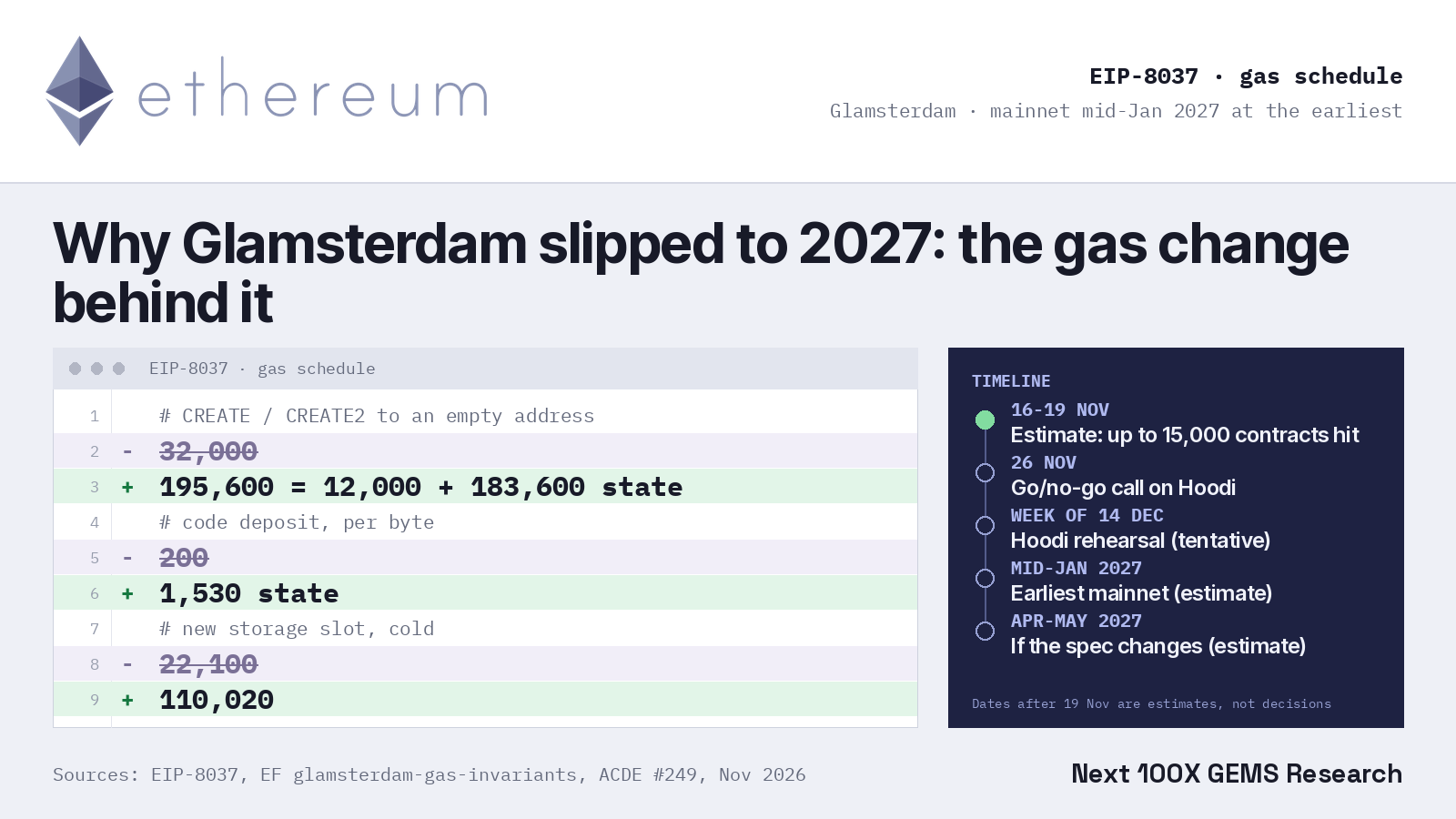
Ethereum's next upgrade, Glamsterdam, won't reach mainnet before mid-January 2027, and Ansgar Dietrichs, who chaired the latest developer call, called late January or early February more realistic. The reason is one gas change. EIP-8037 would raise the state charge for creating a new contract from 32,000 to 183,600 gas, about 5.7 times as much, with similar jumps for new storage and new accounts. Contracts written around the old prices can run out of gas and fail. Ethereum Foundation developer Marius van der Wijden told a core developer call on 16 November that 10,000 to 15,000 contracts could be affected, out of roughly 90 million. On 19 November, client teams leaned toward shipping the rules as written and giving app teams time to patch.
What changes
The repricing exists to slow the growth of Ethereum's state, the database every node has to keep. EIP-8037 says the state took about 390 GiB on a Geth node in January 2026, and that nodes start to struggle around 650 GiB. Developers want to raise the block gas limit from 60 million toward 200 million, a roughly 3.3x jump according to Decrypt. At 200 million gas, the EIP estimates the state would grow about 387 GiB a year at today's prices, and would pass that 650 GiB mark in less than a year.
So EIP-8037 puts a single price on new state. It introduces a "cost per state byte" of 1,530 gas, aimed at about 120 GiB of growth a year, and bills it in a separate "state gas" dimension. A new account counts as 120 bytes, which is where 183,600 comes from. EIP-8038, its companion, raises the cost of reading and writing state that already exists.
The Foundation's invariants repository lists the numbers measured on the current spec:
| Operation | Today | Under Glamsterdam |
|---|---|---|
| CREATE or CREATE2 to an empty address (before init code and code) | 32,000 | 195,600 (12,000 execution + 183,600 state) |
| Code deposit | 200 per byte | 1,530 per byte |
| New storage slot, cold | 22,100 | 110,020 |
| Update an existing slot, warm / cold | 2,900 / 5,000 | 10,100 / 12,100 |
The repository warns that these figures will move if the spec changes.
Who breaks and why
Most transactions just get a different gas estimate and carry on. The trouble is code that assumes a price. The repository lists eight assumptions the fork breaks. ChainSecurity said most of its findings came from two of them, both plain price increases rather than the new accounting.
The commonest is a hard-coded gas amount. One worked example shows how that goes wrong.
Say a vault contract deploys a minimal proxy, a standard 45-byte clone, for each new user. To cap its risk, it calls its factory with a fixed budget: factory.deploy{gas: 150_000}(user). Today the factory's CREATE costs 32,000, plus 45 bytes times 200 for the code, which is 9,000. That's about 41,000 before the short init code runs, well inside 150,000.
After Glamsterdam, the same CREATE costs 195,600, and the 45 bytes cost 45 times 1,530, which is 68,850. That's about 264,500 before any init code. The 150,000 budget runs out partway through and the deployment fails. The new "reservoir" won't help either. It only holds gas when a transaction's limit is above 2^24, about 16.8 million, so for an ordinary transaction all state gas comes out of the same budget the call was given. If the vault's code treats a failed deployment as final, a user can be left stuck.
Factories, account systems that create a wallet on first use, and relayers that sign transactions with a fixed gas field all have this shape. So does any contract sending tokens to a first-time holder, because a new balance means a new storage slot. Auditors also flagged subtler cases tied to the new accounting. A reverted call now gives back the state gas it used, so the caller has more gas left than it expected. And code that charges users by subtracting two gasleft() readings can now be wrong.
Scale matters here. Tanguy Rocher of ChainSecurity reported 152 findings, about half overlapping with the Foundation's own search, for roughly 200 in total. Dedaub looked at about 25,000 contracts with unusual gas use and flagged 70 medium- and high-risk issues, 22 of them new to the Foundation. Van der Wijden put the value at risk in the low hundreds of thousands of dollars, Decrypt reported. App builders weren't reassured. Jango of Juicebox asked on the call whether breaking these assumptions undermines the confidence developers need to build contracts that can never be changed.
The ask to affected teams is concrete. The Foundation's 6 November post told developers to check their code against the eight invariants and write to glamsterdam@ethereum.org if they're affected. For hard-coded gas, the repository's fix is to make limits adjustable, re-estimate under the new rules, and add a margin. Wallets and RPC providers are told to update gas estimation, since cached constants will underestimate. CoinDesk reported that teams have until mid-December to fix their most serious problems and until 10 January for less urgent ones.
The timeline
Glamsterdam had been aimed at December, CoinDesk reported. ChainSecurity's October warning led developers to postpone the Hoodi testnet fork that had been set for 26 October. On 19 November, the Foundation's dev tooling lead Rahul Kothari told the execution-layer call that, after contacting more than 50 affected companies, mid-January was the earliest viable mainnet date if the spec stays as it is. Geth, Nethermind, Reth and ethrex backed going ahead without changes, CoinDesk said. Erigon still wanted changes, and Besu accepted the current approach reluctantly.
Ansgar Dietrichs proposed pencilling in a Hoodi fork for the week of 14 December. The go/no-go call on that is the consensus-layer meeting on 26 November, and a yes would in effect lock the current spec. Those are estimates, not dates. By Dietrichs' own reckoning, reported by Cointelegraph and The Defiant, waiting until January to decide would push mainnet to late February or early March even with the same rules, and rewriting the gas rules would push it to April or May 2027. Van der Wijden warned that one proposed fix, moving refunds to the end of the transaction, would break a different set of contracts.
Sources
- EIP-8037, State Creation Gas Cost Increase: https://eips.ethereum.org/EIPS/eip-8037
- EIP-8038, State Access Gas Cost Update: https://eips.ethereum.org/EIPS/eip-8038
- ethereum/glamsterdam-gas-invariants repository: https://github.com/ethereum/glamsterdam-gas-invariants
- Ethereum Foundation blog, "EIP-8037/EIP-8038 Glamsterdam", 6 Nov 2026 (updated 9 Nov): https://blog.ethereum.org/2026/11/06/glamsterdam-8037-8038
- Ethereum Foundation blog, "Glamsterdam Repricing Impact for Smart Contract Developers", 24 Aug 2026: https://blog.ethereum.org/2026/08/24/glamsterdam-repricing-testing
- Ethereum Magicians, ACDT #103, 16 Nov 2026: https://ethereum-magicians.org/t/all-core-devs-testing-acdt-103-november-16-2026/30326
- Ethereum Magicians, ACDE #249, 19 Nov 2026: https://ethereum-magicians.org/t/all-core-devs-execution-acde-249-november-19-2026/30071
- CoinDesk, 17 Nov 2026: https://www.coindesk.com/tech/2026/11/17/ethereum-s-glamsterdam-upgrade-risks-breaking-up-to-15-000-contracts
- CoinDesk, 20 Nov 2026: https://www.coindesk.com/tech/2026/11/20/ethereum-s-next-big-upgrade-is-pushed-into-2027-by-apps-it-would-break
- Decrypt, 17 Nov 2026: https://decrypt.co/383462
- Cointelegraph, 19 Nov 2026: https://cointelegraph.com/news/ethereum-glamsterdam-could-slip-to-may-2027
- The Defiant, Nov 2026: https://thedefiant.io/news/blockchains/ethereum-execution-teams-lean-toward-keeping-glamsterdam-gas-rules
Next 100X GEMS Research
A crypto community active since 2021, focused on helping newcomers spot scams and understand the market.
How we work