
K3 Capital sBOLD vault exploit: how $3.43M left in minutes, and who actually kept it
The K3 Capital sBOLD vault on Ethereum was emptied on 18 November. Bitquery's trace shows a copycat bot and block builders ended up with 59% of the money, while the wallet that wrote the attack, and one it funded, took about $0.52M. Here is the case file, step by step.

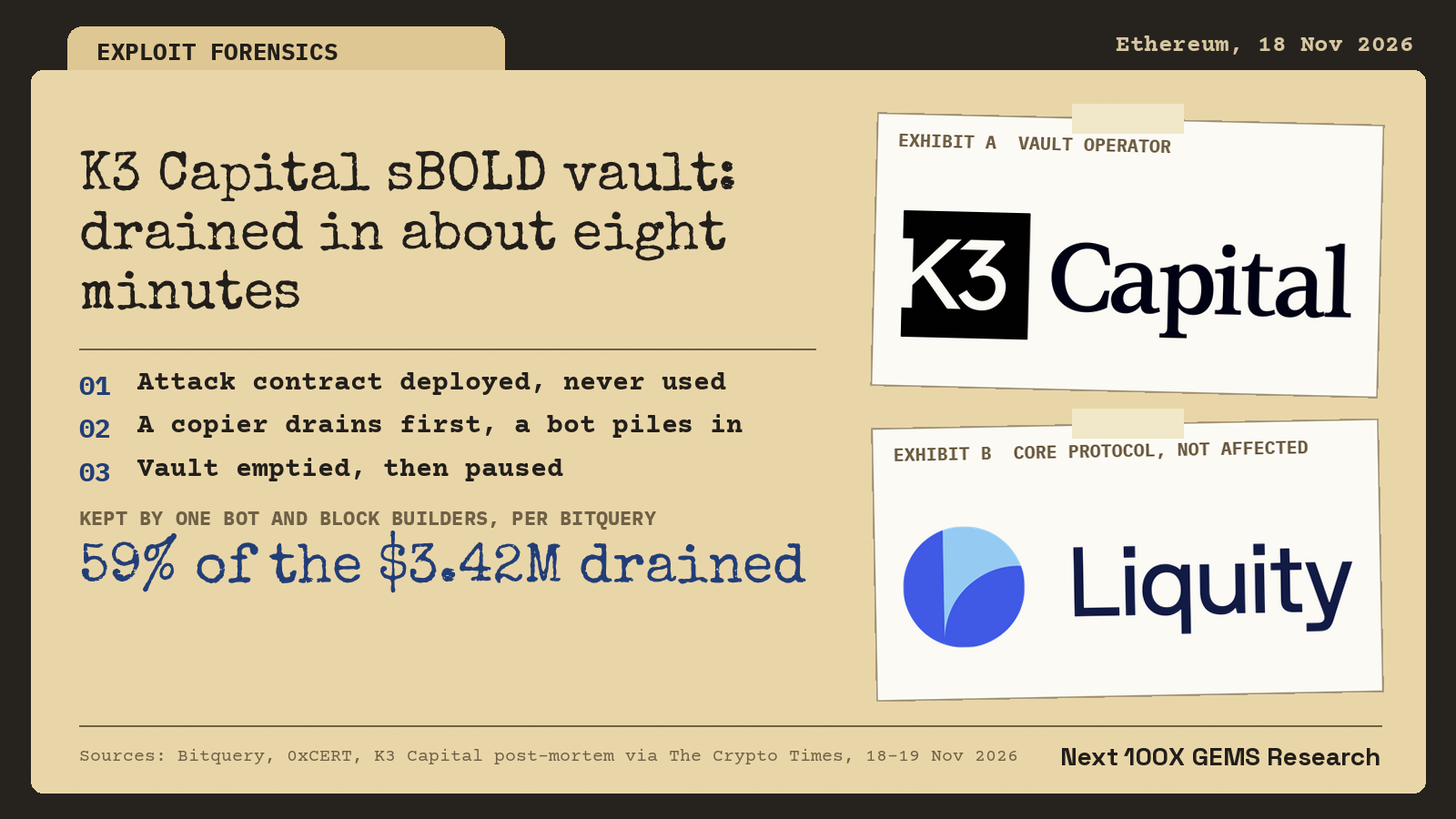
The K3 Capital sBOLD vault exploit on 18 November emptied a Liquity BOLD savings vault on Ethereum in about eight minutes, and most of the money did not stay with the wallet that wrote the attack. Bitquery's on-chain investigation finds that block builders and one copycat bot's payout wallet kept 59% of the 3,428,799 BOLD drained, which Bitquery values at $3.42 million. Blockaid's first alert, as logged by the 0xCERT advisory, put the loss at about $3.43 million, and K3 Capital's own post-mortem says about 3.43 million BOLD, nearly all the vault's assets, per The Crypto Times. Liquity V2's core contracts were not affected, according to Liquity.
Exhibit A: where the money went
Bitquery traced every drain and priced ETH at $1,801. Its split:
| Destination | Value | Share |
|---|---|---|
| Block builders (Titan, BuilderNet, Ultrasound, Quasar), 986 ETH in bribes | $1.78M | 52% |
| Copycat bot's payout wallet | $231K | 7% |
| 0xdc0e, the attack's author, to THORChain | $292K | 9% |
| 0xdc0e group via Maya Protocol to five Bitcoin addresses | $232K | 7% |
| 0xbabe and a fresh wallet | $216K | 6% |
| 0xf601 | $174K | 5% |
| 0x2324, the first copier | $75K | 2% |
| Fees and costs | $428K | 13% |
The bot, run from 13 wallets through one contract, sent 57 of the 97 drain transactions and pulled out $1.91 million, 56% of the total. It paid about nine tenths of that to builders to put its transactions first, raising its bribe from 12.5 ETH to 44 ETH per block. K3 Capital's post-mortem, as reported by The Crypto Times, adds that builders passed 986.55 ETH to 21 validator fee recipients across 32 blocks, and that Lido's execution-layer rewards vault received 256.31 ETH across nine of them. K3 says it does not accuse the builders.
Exhibit B: the timeline
All steps fall on 18 November unless marked, shown as gaps between them.
- Wallet 0xdc0e deploys the attack contract, then never calls it.
- Eleven minutes later, 0x2324, a wallet Bitquery says had run as an MEV bot since late 2025, executes a byte-identical copy with its own addresses swapped in. It is the first to drain.
- Twenty-four seconds after that, the author's own first drain lands.
- Within about a minute and a half of the first drain, wallets 0xbabe and 0xf601 join. The copycat bot arrives in the same stretch.
- Near the end, 0xdc0e sends 1 ETH to a second wallet, 0x8fb8, which deploys the same code and drains in three of the last four blocks.
- About eight minutes after the first drain, almost nothing is left in the vault, per Bitquery. K3 says 99.9% of assets were gone in about 7.5 minutes.
- About 40 minutes after the first drain, the pause transaction lands on-chain, per SigIntZero's block read. K3 posts on X that the contracts are paused.
- 19 November: K3 publishes its post-mortem with technical analysis by ChainSecurity, the vault's auditor, and offers a 15% bounty.
The counts differ by source: about 34 transactions in Blockaid's alert, 97 in Bitquery's trace, 99 across ten operators in K3's post-mortem. Bitquery also found zero troves liquidated, which contradicts the first alerts that blamed self-liquidation.
Exhibit C: the bug, in plain words
sBOLD is an ERC-4626 vault. Its share price is the value of everything it holds divided by the shares outstanding: BOLD in Liquity's Stability Pools plus any collateral, such as WETH, priced by oracle. Push that value up while you own most of the shares and you can redeem for more than you put in.
The vault has a public swap() function meant to turn collateral back into BOLD through 1inch's router. We read the verified source on Sourcify. swap() approves the router to spend the collateral, makes a call using data the caller writes, and then checks one thing: that the vault's BOLD balance went up enough. It never checks that the collateral actually left, and it never clears the approval.
SigIntZero and K3 describe the loop. An attacker deposited a large amount of BOLD for most of the shares, sent the vault 4 WETH, then called swap() with data that paid the vault about 7,159 BOLD while the WETH stayed put. The vault now counted both the new BOLD and the WETH, so each share looked richer, and the attacker redeemed. A second swap() using the leftover approval pulled the 4 WETH back out. K3 sums it up in its post-mortem, as quoted by The Crypto Times: "The root cause is a token approval that the vault left in place after a swap that never took the collateral." A cap of 7,500 BOLD on idle collateral, per SigIntZero's on-chain read, limited each round, and K3 says gas limits held each transaction to about eight rounds.
Exhibit D: the audit question
ChainSecurity's sBOLD audit, dated 19 May 2025, rated finding CS-SBOLD-008 High. In the first audited version, collateral below the maxCollInBold threshold was left out of the share price, so an attacker could mint shares cheaply, call swap() and redeem. Early alerts and Bitquery's write-up linked the drain to that pattern, and Bitquery says it did not check which version K3 runs.
The record points elsewhere. The audit marks CS-SBOLD-008 "Code Corrected" in Version 3, where collateral is included in the valuation. The source verified on Sourcify for the vault address 0x50Bd66D5...59DD11 adds the collateral value to the BOLD total with no threshold carve-out, which matches SigIntZero's reading. On that evidence the fix was deployed, and the exploit used a different path. The audit's system overview does describe swap() checking only for the BOLD increase. We found no finding in it on the leftover approval.
Exhibit E: what K3 has done
K3 paused the contracts, and a call we made on 20 November returned paused as true with about 4.5 BOLD left. It is offering a 15% bounty on returned funds, has named a single recovery address, and says Bitcoin Suisse and Yearn have committed to help recover about 1.7 million BOLD of identified holdings. Repayment to depositors will depend on what is recovered. Pendle's sBOLD market held 12.79% of shares, and those losses are not yet quantified. Liquity advised against depositing into sBOLD. For another accounting failure from the same week, see our report on the Kava Lend exploit.
Sources
- Bitquery investigation: https://bitquery.io/investigations/k3-capital-sbold-hack
- 0xCERT-2026-0376: https://www.0xcert.com/advisory/0xCERT-2026-0376
- ChainSecurity sBOLD audit (PDF): https://reports.chainsecurity.com/K3Capital/ChainSecurity_K3Capital_SBOLD_Audit.pdf
- SigIntZero: https://sigintzero.com/blog/k3-capital-3-43m-sbold-unchecked-swap-input
- The Crypto Times on K3's post-mortem: https://www.cryptotimes.io/2026/11/19/k3-capital-offers-15-bounty-to-recover-3-43m-lost-in-sbold-exploit/
- Sourcify verified source: https://sourcify.dev/server/v2/contract/1/0x50Bd66D59911F5e086Ec87aE43C811e0D059DD11?fields=sources
- K3 Capital on X: https://x.com/k3_capital/status/2123040539578970305
- Liquity on X: https://x.com/LiquityProtocol/status/2123053380893573433
Next 100X GEMS Research
A crypto community active since 2021, focused on helping newcomers spot scams and understand the market.
How we work