
Pearl v. Coinbase, 22-cv-03561-MMC: dismissed without further leave to amend
On 20 November 2026, Judge Maxine M. Chesney of the Northern District of California dismissed the Fourth Amended Class Action Complaint in Pearl v. Coinbase, Inc., No. 22-cv-03561-MMC, without further leave to amend. The motion to strike class allegations was denied as moot.

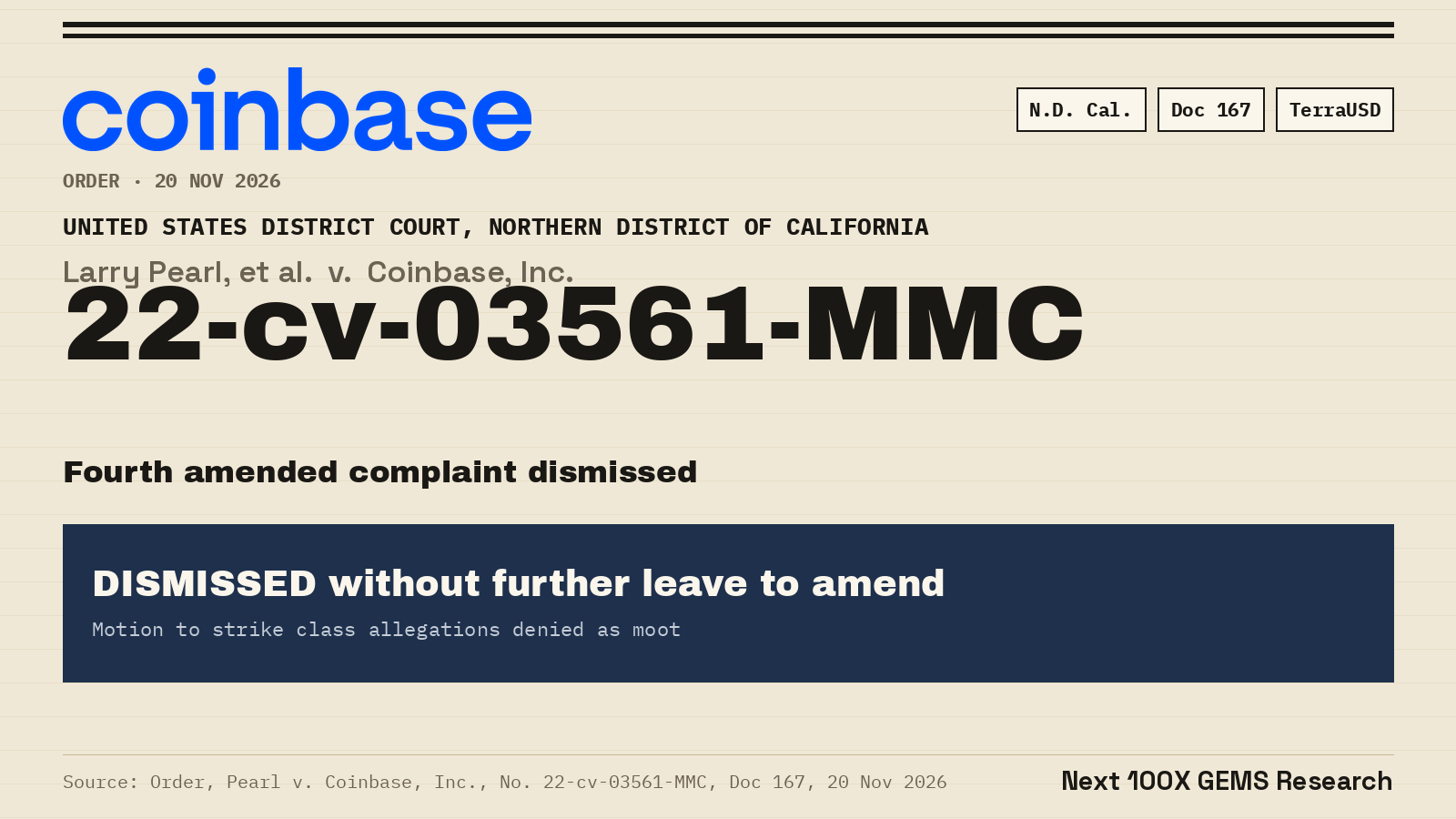
On 20 November 2026, Judge Maxine M. Chesney of the U.S. District Court for the Northern District of California granted Coinbase, Inc.'s motion to dismiss the Fourth Amended Class Action Complaint in Pearl v. Coinbase, Inc., No. 22-cv-03561-MMC (Doc. 167). The complaint was "DISMISSED without further leave to amend." A motion to strike class allegations was denied as moot.
The order does not use the words "with prejudice." A dismissal without further leave to amend is treated as a dismissal with prejudice of the claims in that complaint. These plaintiffs cannot plead the same claims again in that court.
From the second amended complaint to the fourth
Larry Pearl filed the suit on 16 June 2022, according to CourtListener. He alleged that in May 2022 he "purchase[d]" TerraUSD (UST) from Coinbase, that Coinbase's website described it as a "stablecoin," that by 9 May 2022 it had "dropped to 35 cents" from its intended "1-dollar peg," and that when UST collapsed, the value of his investment "fell in value by over 90 percent." Those figures are his allegations, recited in the November order.
The operative complaint asserted seven counts: negligent misrepresentation, California's Unfair Competition Law and False Advertising Law, and claims under the California Corporations Code.
It was not the first dismissal. On 15 July 2024 the court dismissed the Second Amended Complaint (Doc. 74). On 8 August 2025 it dismissed the Third Amended Complaint (Doc. 119) with limited leave. Pearl could re-plead the consumer counts only as to affirmative "misrepresentation[s] as to legitimacy and/or reliability," not "collaterization or safety," the court's spelling, and could amend the UCL and FAL, but not negligent misrepresentation, as to omissions. Claims under §§ 25110 and 25503, and under §§ 25401 and 25501, were dismissed without leave. He was allowed to add claims under §§ 25130, 25400(d), 25504 and 25504.1. The Fourth Amended Complaint was filed on 9 September 2025.
Judge Chesney first dismissed everything outside that leave. Count I went out in full: Pearl had not re-pleaded negligent misrepresentation on legitimacy or reliability, had put it back on collateralization and safety, and had added an omissions theory he was not allowed to bring on that count. A footnote added that, even if he had been, "negligent misrepresentation by omission is not recognized in California." Counts II and III were dismissed to the extent they rested on affirmative misrepresentations. Counts IV and V were dismissed again after he re-alleged claims already thrown out without leave.
What the Coinbase page already said
What remained of the UCL and FAL claims was an omissions theory. Pearl alleged two partial representations: that UST was a "stablecoin" that "attempts to maintain a value of 1.00 US dollars," and that stablecoins are "free from the volatility of non-pegged cryptocurrencies." He said those lines omitted that UST held its peg through an algorithmic link to LUNA.
The court held he had not pleaded an actionable partial representation. The complaint itself alleged that Coinbase's website said "in order to mint 1 TerraUSD, 1.00 US dollars worth of TerraUSD's reserve asset (LUNA) must be burned." Immediately after the "attempts to maintain a value of 1.00 US dollars" line, the same page said "UST isn't backed by US dollars in a bank account." The page also linked a whitepaper describing how the system "uses L[UNA] to make the price for [UST]" and adjusts supply "using L[UNA]." The court took judicial notice of those materials for "what was in the public realm" at the relevant time.
The exclusive-knowledge theory failed as well. The LUNA relationship was on the site and in the whitepaper, and Pearl had not alleged facts showing it was hard to discover. The complaint still "includes no allegation demonstrating the UST algorithm was, in fact, untested." Trading histories for UST and LUNA were on Coinbase's own price charts, which Pearl said he had relied on. An SEC investigation of Terraform Labs' Mirror Protocol had been public for months before his purchase, including an SEC press release on 12 November 2021. Counts II and III were dismissed.
Whether UST was pleaded as a security
Count VI and, in part, Count VII depended on UST being a security. California uses both a risk-capital test and the federal Howey test for an "investment contract" under Corporations Code § 25019. The risk-capital theory was treated as abandoned.
On Howey, Pearl had not adequately pleaded a common enterprise or an expectation of profit. His common-enterprise allegation was a conclusory claim that "the fortunes of UST investors were tied to one another and to those of Terraform Labs and its founder and Chief Executive Officer, Do Kwon." He could not repair that by importing facts from SEC v. Terraform Labs Pte. Ltd., 708 F. Supp. 3d 450 (S.D.N.Y. 2023), through an opposition brief. On profit, he alleged he bought UST because he "understood that UST was a standard stablecoin" "designed to maintain a value of 1.00 dollars per coin." The court cited Terraform Labs itself for the point that "UST on its own was not a security" where purchasers understood its value would stay at 1.00 dollars rather than generate a profit.
The securities claims failed on other grounds as well. Section 25503 requires privity. Pearl again did not allege that he bought UST from Coinbase or that Coinbase held title, and California has rejected the federal "statutory seller" theory. For § 25504, a 2021 SEC investigation of Mirror Protocol did not plead that Coinbase knew or had reason to know UST was an unregistered security, and a February 2023 SEC allegation post-dated the May 2022 trades. "There is no dispute that UST was not registered as a security." Count VII also failed because the volatility statement had already been held, in the August 2025 order, not to be false or misleading, and because Pearl attributed the collapse to "over 2 billion US dollars worth of UST" being removed from a Terraform Labs mechanism, not to Coinbase.
Without further leave to amend
Paul, Weiss, counsel for Coinbase, described the 20 November ruling on 24 November 2026 as a complete dismissal with prejudice. The Block reported on 23 November 2026 that judgment was entered three days after the order, terminating the case. CourtListener's public docket lists 23 November 2026 as the date of last known filing. A notice of appeal did not appear on the CourtListener docket as of 25 November 2026. In a civil case to which the United States is not a party, Federal Rule of Appellate Procedure 4(a)(1)(A) generally requires that a notice of appeal be filed within 30 days after the judgment or order appealed from is entered.
Sources
U.S. District Court for the Northern District of California, Order Granting Motion to Dismiss; Denying Motion to Strike as Moot, Pearl v. Coinbase, Inc., No. 22-cv-03561-MMC, Docket No. 167, 20 Nov 2026 (RECAP)
Same order, GovInfo
CourtListener docket, Pearl v. Coinbase, checked 25 Nov 2026 (date filed 16 June 2022; date of last known filing 23 Nov 2026)
Paul, Weiss, "Coinbase Secures Complete Dismissal With Prejudice of Class Action Over Its Listing of Stablecoin TerraUSD," 24 Nov 2026
The Block, Danny Park, "California court terminates lawsuit against Coinbase over TerraUSD purchases," 23 Nov 2026
Federal Rule of Appellate Procedure 4(a)(1)(A)
Next 100X GEMS Research
A crypto community active since 2021, focused on helping newcomers spot scams and understand the market.
How we work