
Upbit and Bithumb put SKY and USDS on trading warning as USDS hit 7,835 won on Upbit
On 23 November, Upbit and Bithumb designated SKY and USDS as trading-warning assets and stopped deposits. Coinone flagged both. With deposits blocked, Upbit's USDS printed 2,790 won against USDT at 1,362 won, then as high as 7,835 won.

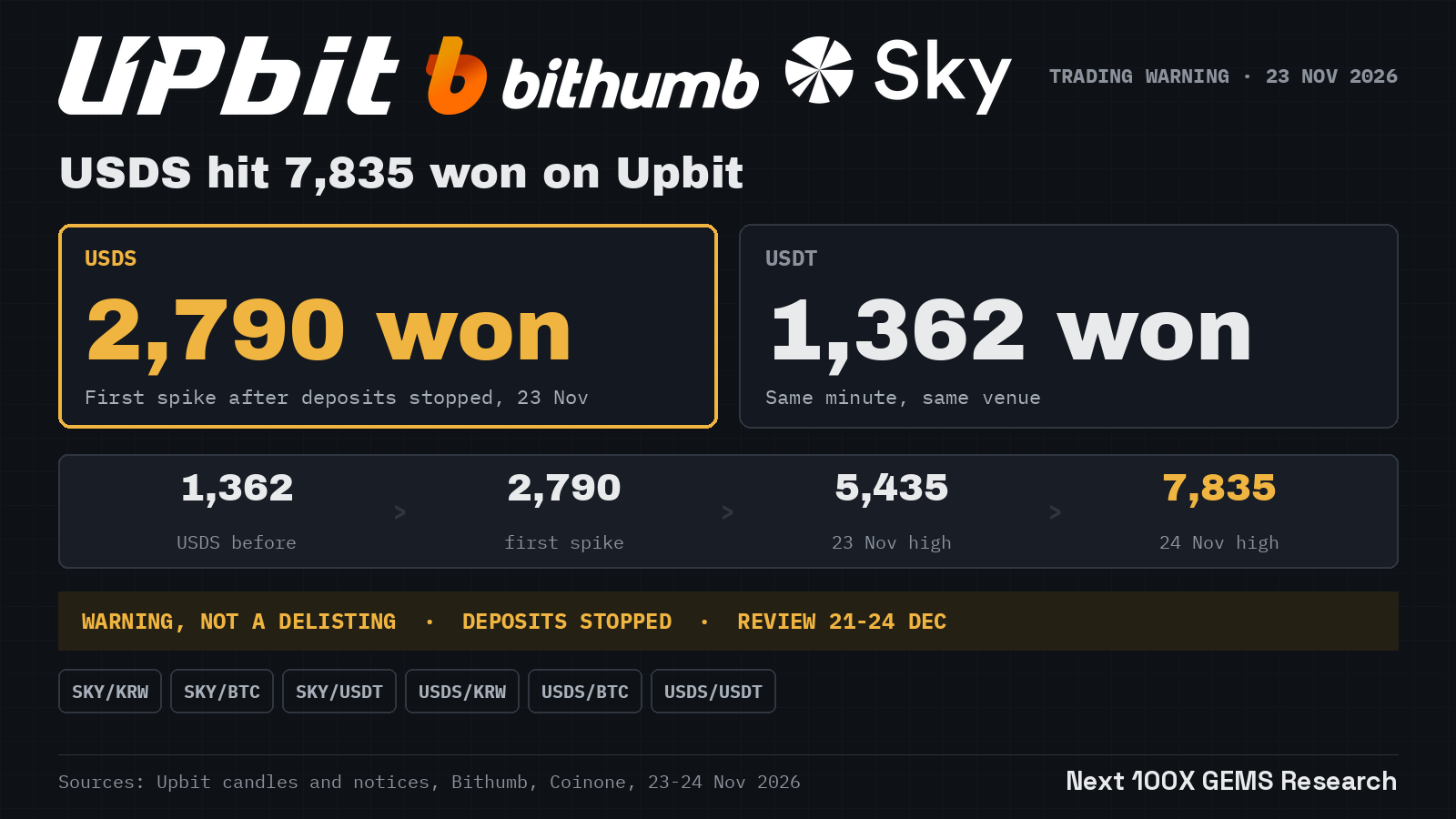
On 23 November 2026, shortly after Upbit stopped deposits of USDS, the dollar stablecoin printed 2,790 won on Upbit's won market. In the same one-minute candle, USDT on the same exchange last traded at 1,362 won. Coinyong reported the 2,790 won print the same day. Upbit's one-minute candles, checked on 24 November, show that exact high, and the matching USDT last price.
That was only the first jump. The same KRW-USDS market's high on 23 November was 5,435 won, according to Upbit's daily and minute candles. On 24 November it printed as high as 7,835 won. USDT on Upbit barely moved, staying between 1,356 and 1,367 won on 23 and 24 November.
USDS is Sky Protocol's dollar stablecoin, built to stay near one dollar. SKY is its governance token. A 2,790 won print, against USDT at 1,362 won, is roughly double. None of this is a delisting. It is what happened on one venue after deposits were blocked.
What the notices actually say
On 23 November, Upbit put SKY and USDS on a trading warning (거래 유의) across six pairs, SKY and USDS against KRW, BTC and USDT, and stopped deposits of both. The review runs to the fourth week of December, 21 to 24 December, after which the warning can be extended, lifted, or trading support can end. Upbit cited the Virtual Asset User Protection Act Enforcement Decree, Article 17(1)(e), and said a review of the issuers' and operators' capability, credibility, business history and disclosure had found a risk of harm to users. It did not name a specific incident.
Bithumb issued its own notice the same day for SKY and USDS, also stopping deposits, and citing the same decree provision. It pointed to questions about the substance, sustainability and actual progress of the related business, and about the reliability of the issuing or operating entities. It too set a follow-up notice for 21 to 24 December, and said the timetable can change. It named no specific event.
Coinone issued two notices the same day and stopped deposits of both assets. Notice 5989 flagged USDS, on Ethereum. Unlike Upbit and Bithumb, it gave a concrete reason: a change in Sky Protocol's terms that, Coinone said, restricts liquidation of collateralised loans, may leave losses to be absorbed by staked USDS (stUSDS), and raises the possibility of withdrawals being restricted for a long period. Notice 5990 flagged SKY, also on Ethereum. Coinone said the liquidation function on the related collateralised-loan service had been disabled, and that some loan positions had problems with collateral quality and liquidity. It said it would keep each asset on a trading warning for about one month, then decide whether to extend the warning, lift it, or end trading support. Trading, it said, continues.
What holders can and cannot do
Upbit said deposits sent after the cut-off may not be credited, and that if they are not, recovery may be impossible. Uncredited deposits would be returned only after deposits resume, it said. Bithumb warned that even transfers started before the cut-off might not be credited if the network is congested, and that deposits arriving during the stop will be handled later, when the warning is lifted or trading support ends. Coinone said uncredited deposits can be returned if the holder files a return request.
Trading itself has not been halted. That is the difference between a trading warning and a delisting. Ending trading support is one possible outcome of the later review, not a decision already taken.
Why the won price stopped acting like a dollar
Before the notices, USDS on Upbit's won market was still trading in line with USDT. Upbit's daily candle for 23 November opens at 1,361 won. In the minutes just before deposits were stopped, USDS was around 1,362 to 1,365 won, with USDT in the same band.
Once inbound transfers are blocked, the usual arbitrage cannot operate on that venue. Nobody can bring more USDS in from outside and sell it there. If buy orders outrun the inventory already on the exchange, the won price can disconnect from the dollar the token is designed to track. USDT, which was not placed on the warning, did not make the same move.
Upbit's KRW-USDS market turned over about 12.5 million won on 22 November, and about 130.6 billion won on 23 November, per those daily candles. A print of 2,790 won, or 5,435 won, or 7,835 won, is the price of USDS on Upbit in won. It is not a new official dollar value for the token, and it does not mean the same price was available everywhere.
What came before, and what two of the notices left unsaid
Upbit and Bithumb did not tie their warnings to the Sky-related events of the previous week.
On 19 November, CoinDesk, citing Inca Digital, reported that 422 wallets linked to hackers, phishing groups and sanctioned parties had transacted about $518 million through Sky's Peg Stability Module, which swaps USDS and USDC one for one, and that about $101.9 million was "directly linked" to North Korean-linked actors. The report also raised the possibility that USDC in a shared module address could be frozen.
Sky Frontier Foundation said on 20 November that users had exchanged more than $2 billion of USDS for USDC through the module on 19 November, always at one for one, and that USDC in the module did not fall below $800 million. It put the collateral backing USDS and DAI at about $9.3 billion. Block Analitica, whose review the Foundation released, said the flagged activity was less than 0.06% of the roughly $960 billion the modules have processed, and disputed several of CoinDesk's claims. We have not independently audited either review.
Sky's stUSDS savings pool had already reached full utilisation. In our 21 November piece, we reported that the pool was fully lent, so savers could leave only when someone repaid or deposited, and that a Safe linked by Bitquery and Oak Research to Rune Christensen owed about 48% of it. Coinone is the exchange that put that kind of issue in its notice. Upbit and Bithumb did not.
The decision in late December
Upbit and Bithumb have told holders to expect a further notice in the fourth week of December, between 21 and 24 December. The choices are the same: extend the warning, lift it, or end trading support. Coinone's clock is "about one month," with the same three outcomes. Bithumb noted that its dates can change. Until then, SKY and USDS still trade on those venues, and new deposits do not.
Sources
- Upbit, "스카이프로토콜(SKY), 유에스디에스(USDS) 거래 유의 종목 지정 안내," notice id 6818, 23 Nov 2026: https://www.upbit.com/service_center/notice?id=6818
- Bithumb, "스카이프로토콜(SKY), 유에스디에스(USDS) 거래유의종목 지정," notice 1655779, 23 Nov 2026: https://feed.bithumb.com/notice/1655779
- Coinone, "거래유의 종목 지정 안내: 유에스디에스(USDS)," notice 5989, 23 Nov 2026: https://coinone.co.kr/info/notice/5989
- Coinone, "거래유의 종목 지정 안내: 스카이 프로토콜(SKY)," notice 5990, 23 Nov 2026: https://coinone.co.kr/info/notice/5990
- Upbit public API, daily candles for KRW-USDS, KRW-USDT and KRW-SKY, and one-minute candles for KRW-USDS and KRW-USDT, checked 24 Nov 2026: https://api.upbit.com/v1/candles/days?market=KRW-USDS&count=5
- Coinyong, "업비트, 스카이(SKY)·USDS 거래 유의 지정…USDS 2천원 넘어," 23 Nov 2026: https://coinyong.com/news/sky-1123-upbit-caution
- PANews, "Upbit and Bithumb Flag SKY and USDS as Trading Warning Assets," 23 Nov 2026: https://www.panews.io/articles/01a2081e-700a-71ec-a6ee-c7beccf891c7
- FinanceFeeds, Abdelaziz Fathi, 23 Nov 2026: https://financefeeds.com/upbit-bithumb-put-sky-and-usds-on-delisting-watchlist/
- CoinDesk, "North Korean hackers used Sky's stablecoin system, putting billions at freeze risk," 19 Nov 2026: https://www.coindesk.com/business/2026/11/19/north-korean-hackers-used-sky-s-stablecoin-system-putting-billions-at-freeze-risk
- Sky Frontier Foundation, via PR Newswire, "Sky Protocol Shows Resilience Through Record $2 Billion Day as Review Finds CoinDesk Report Misleading," 20 Nov 2026: https://www.prnewswire.com/news-releases/sky-protocol-shows-resilience-through-record-2-billion-day-as-review-finds-coindesk-report-misleading-302947100.html
- Next 100X GEMS, "Sky's stUSDS pool is fully lent and one wallet owes 48%: how savers got stuck," 21 Nov 2026: https://next100xgems.io/news/sky-stusds-pool-fully-lent-rune-eth-wallet-owes-48-percent
Next 100X GEMS Research
A crypto community active since 2021, focused on helping newcomers spot scams and understand the market.
How we work