
CFTC Staff Letter 26-31: bitcoin, ether and stablecoins can now count toward exchange reserves
Two CFTC divisions say swap execution facilities, contract markets and clearinghouses may count bitcoin, ether and payment stablecoins toward a year of operating costs, after haircuts of at least 20% and 2%. The cash-only slice of that year is untouched, and the letter is a staff view, not a rule.

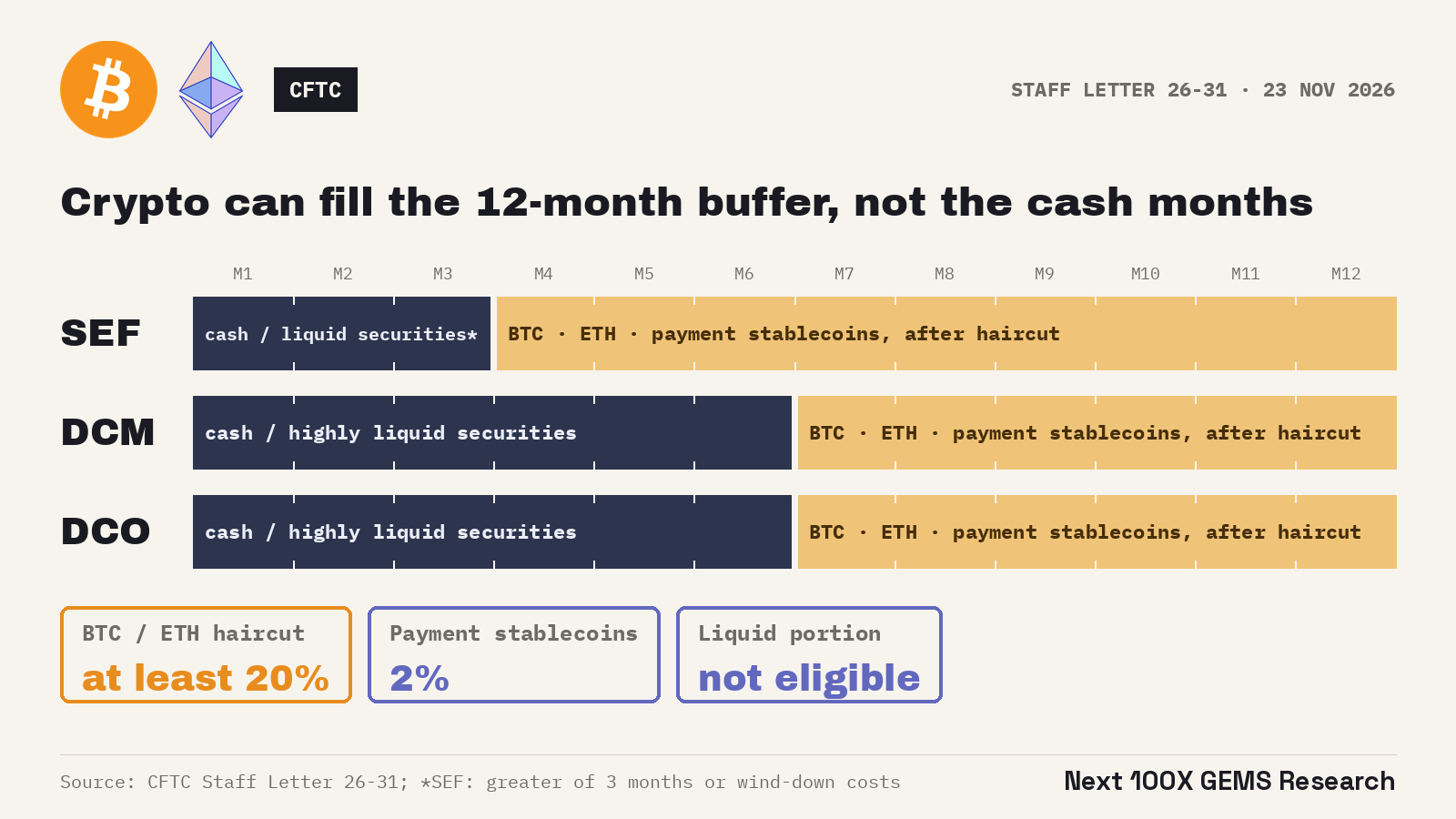
Yes, with two limits. CFTC Staff Letter No. 26-31, dated 23 November 2026, says a swap execution facility (SEF), designated contract market (DCM) or derivatives clearing organization (DCO) may count bitcoin, ether and payment stablecoins toward the financial resources it must hold to cover one year of operating costs, under Regulations 37.1301, 38.1101(a) and 39.11(a)(2). The assets must be haircut first. Staff would not object to at least 20% off bitcoin and ether and 2% off payment stablecoins. And none of them can fill the part of that year that must sit in cash or highly liquid securities.
What kind of document this is
The letter is a staff advisory from the Division of Market Oversight and the Division of Clearing and Risk. It is signed by Duncan Hennes, Acting Director of Market Oversight, and Richard Haynes, Acting Director of Clearing and Risk. The CFTC announced it the same day in press release 9331-26.
Its closing section is blunt about its limits. The advisory does not create rights, does not provide a no-action position, does not create or amend rules, and "represents only the views of the Divisions and does not necessarily represent the views of the Commission." The letter says it was written because registered entities and applicants now hold crypto assets in their businesses and had asked whether those holdings could count.
The rule it reads
All three regulations share one structure, the letter notes. Each venue must hold financial resources that exceed a year of operating costs, calculated on a rolling basis. Each may count its own capital, meaning assets minus liabilities under US accounting standards (GAAP), plus "any other financial resource deemed acceptable by the Commission." Each must mark those resources to market and apply haircuts. And each must keep part of the year in "unencumbered, liquid financial assets (i.e., cash and/or highly liquid securities)."
That last slice differs by venue. For a SEF it is the greater of three months of projected operating costs or the projected cost of winding down, under Regulation 37.1303. For a DCM it is six months, under 38.1101(e). For a DCO it is six months, under 39.11(e)(2).
Staff's position fills the gap between those numbers. Crypto can sit in the "other acceptable resources" bucket. It cannot sit in the liquid slice, because, in the letter's words, crypto assets "do not qualify for classification as 'cash' for GAAP reporting purposes and do not constitute 'highly liquid securities,' as they are non-security crypto assets."
The asset table
| Asset | Counts toward the 12-month requirement? | Haircut staff would not object to | Counts toward the liquid portion? |
|---|---|---|---|
| Bitcoin | Yes | At least 20% | No |
| Ether | Yes | At least 20% | No |
| Payment stablecoin (as the letter defines it) | Yes | 2% | No |
| Other crypto asset that is readily marketable | Not addressed; venue should engage with staff | Not set | No |
| Crypto asset that is not readily marketable and not a payment stablecoin | Generally no | Generally 100% | No |
The haircut figures are borrowed. Staff points to the treatment it already accepts for futures commission merchants' proprietary crypto positions in regulatory capital, set out in the CFTC's crypto questions-and-answers guidance. The basis also differs by venue. SEF and DCM haircuts reflect market and credit risk. DCO haircuts must also reflect liquidity risk, and DCOs must evaluate them monthly.
A worked example (hypothetical)
The figures below are invented round numbers to show the arithmetic. They do not describe any real venue.
Take a hypothetical DCO with 12 million dollars a year in projected operating costs. It must hold more than 12 million dollars of qualifying financial resources. At least 6 million dollars, the six-month liquid slice, must be cash or highly liquid securities. Crypto can cover at most the other 6 million dollars.
To fill that 6 million dollars with bitcoin at a 20% haircut, the DCO would need 7.5 million dollars of bitcoin at market value, since 80% of 7.5 million is 6 million. Filled with payment stablecoins at 2%, it would need about 6.12 million dollars. If bitcoin then fell 25%, the 7.5 million would be worth about 5.63 million before the haircut and 4.5 million after it. The DCO would be roughly 1.5 million dollars short until it topped up.
The same 12 million dollar budget at a SEF would leave more room. The liquid slice there is three months, or 3 million dollars, unless wind-down costs are higher. That leaves up to 9 million dollars for other acceptable assets.
The letter tells venues to weigh exactly that scenario. Each should consider "wrong-way risk," such as operating losses that arrive alongside falling crypto prices.
What counts as a payment stablecoin
The definition changes with the GENIUS Act's effective date. Before it, a payment stablecoin for this advisory is a USD-denominated stablecoin that meets three tests:
- it is issued by a state-regulated money transmitter, a state-regulated trust company or a national trust bank;
- its reserves are limited to direct or indirect investments in cash, US Treasury securities or overnight Treasury repurchase agreements;
- it publishes monthly attestations on the composition of those reserves and whether their fair value matches the coins in circulation.
After that date, the coin must meet the Act's own definition of a payment stablecoin and be issued by a permitted payment stablecoin issuer, or by a foreign payment stablecoin issuer that complies with the Act.
What the letter leaves alone
The advisory says nothing about a DCO's default resources under Regulation 39.11(a)(1), the separate pool that covers a clearing member's failure. It does not address how non-crypto assets should be valued. Venues that want to use any crypto asset other than bitcoin, ether or a payment stablecoin are told to talk to the relevant division first.
The letter builds on earlier staff work: the December 2025 letters on digital assets as margin collateral (25-40, reissued as 26-05) and tokenized collateral (25-39), and the crypto questions-and-answers guidance reissued in September 2026. For more on how the CFTC is defending its turf over event contracts in court, see our piece on Kalshi v. New York.
Sources
- CFTC Staff Letter No. 26-31, Staff Advisory, Division of Market Oversight and Division of Clearing and Risk, 23 Nov 2026: https://www.cftc.gov/csl/26-31/download
- CFTC press release 9331-26, 23 Nov 2026: https://www.cftc.gov/PressRoom/PressReleases/9331-26
Next 100X GEMS Research
A crypto community active since 2021, focused on helping newcomers spot scams and understand the market.
How we work