
SI 2026/1219 Article 9UA: market makers skip the Article 9T permission, but FCA PS26/11 keeps UK crypto platforms off their own books
From 25 October 2027, market making on a qualifying crypto trading platform falls outside the UK's Article 9T dealing permission. The FCA's PS26/11 rules stop a platform operator from doing it on its own venue. We read both texts line by line.

From 25 October 2027, a firm that makes markets on a qualifying cryptoasset trading platform will not need the UK permission for dealing in qualifying cryptoassets as principal (Article 9T) for that activity. The operator of a UK platform, however, cannot make markets on its own venue at all. The first half comes from Article 9UA, added by SI 2026/1219, which HM Treasury made on 18 November 2026. The second half comes from the FCA's final rules in PS26/11, specifically CRYPTO 6.6.1R.
One text moves the edge of what needs a licence. The other tells licensed venues what they may do inside it.
The new article, word for word
Article 9UA sits under the heading "Article 9T exclusions: proprietary trading". It reads:
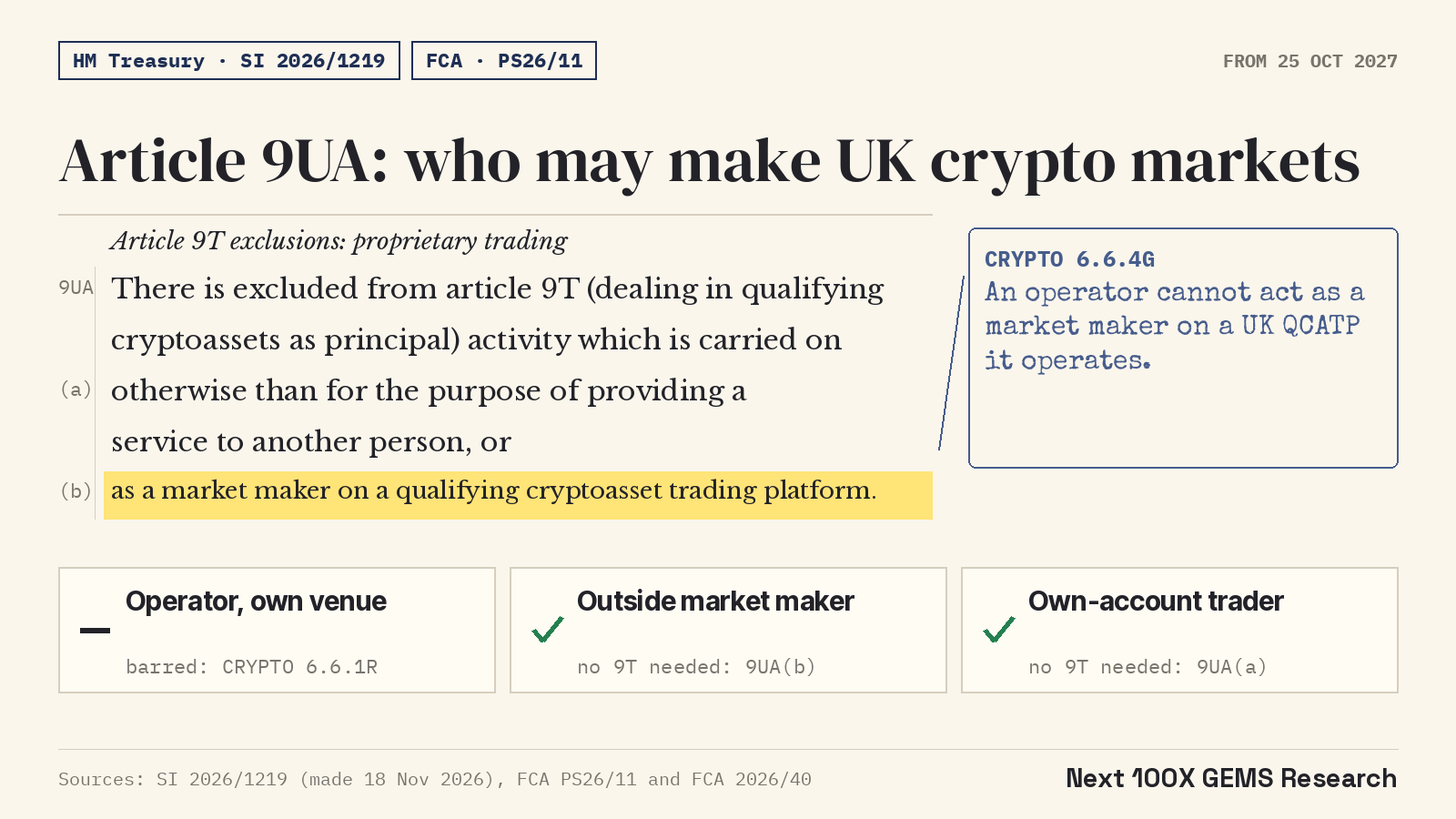
"There is excluded from article 9T (dealing in qualifying cryptoassets as principal) activity which is carried on (a) otherwise than for the purpose of providing a service to another person, or (b) as a market maker on a qualifying cryptoasset trading platform."
Three things matter.
First, the "or". A firm needs to fit only one limb.
Second, limb (b) says nothing about who the market maker is. It doesn't say "third party". On its face it covers anyone making markets on a qualifying platform. The bar on operators doesn't come from the statute. It comes from FCA rules, which is why the two texts have to be read together.
Third, the exclusion names only Article 9T. Operating a platform, arranging deals and safeguarding are separate activities, and the article doesn't touch them.
The article is inserted by regulation 4(5)(b)(vi) of SI 2026/1219. That regulation amends SI 2026/102, the Financial Services and Markets Act 2000 (Cryptoassets) Regulations 2026, which writes the new crypto activities into the Regulated Activities Order. SI 2026/1219's own amending text came into force the day after it was made. The articles it amends, Article 9UA among them, only bite when SI 2026/102 reaches its "full commencement day": 25 October 2027.
The rule on the other side
PS26/11, published in June 2026, carries the FCA's final crypto rules. Its trading platform instrument (FCA 2026/40) was made on 25 June 2026 and says:
CRYPTO 6.6.1R: "A firm must not execute any orders against its proprietary capital on a UK QCATP it operates, except where CRYPTO 6.6.2R applies."
CRYPTO 6.6.4G spells it out: "The effect of CRYPTO 6.6.1R is that a firm cannot act as a market maker on a UK QCATP it operates."
The exception in 6.6.2R is narrow. An operator with the appropriate permission may trade as matched principal to execute client orders on its own venue, "when acting in accordance with the non-discretionary rules of the UK QCATP." Off its own venue, 6.6.6R lets an operator with the right permission trade against its own capital, as long as it tells clients what capacity it is acting in and manages conflicts.
Who can do what from 25 October 2027
| Role | Make markets on a UK platform? | Needs the Article 9T permission for it? | Text that decides it |
|---|---|---|---|
| Operator, on its own UK platform | No | Not applicable | CRYPTO 6.6.1R and 6.6.4G |
| Operator, matched-principal execution of client orders on its own platform | Not market making | Yes, limited to matched principal trading | CRYPTO 6.6.2R and 6.6.7G |
| Operator, trading against its own capital away from its platform | Not on its own venue | Yes | CRYPTO 6.6.6R and 6.6.7G |
| Outside firm making markets on a qualifying platform | Yes | No, for that activity | Article 9UA(b) |
| Firm trading only for itself, serving no one | Not relevant | No | Article 9UA(a) |
| Dealer serving clients as principal outside any platform | Not relevant | Yes | Article 9T; no exclusion applies |
Two notes. Limb (b) needs the venue to be a "qualifying cryptoasset trading platform", which the draft guidance says can be run by an authorised or unauthorised person. And PS26/11 confirms the FCA went ahead with letting an operator's affiliates trade on its platform, subject to conflict controls. The prohibition binds the operating firm.
Three definitions that carry the weight
A qualifying cryptoasset trading platform, under SI 2026/102, is "a system in which multiple third-party buying and selling trading interests in qualifying cryptoassets are able to interact within the system" and which brings those interests together so that a contract results to exchange them for money or other qualifying cryptoassets. A single firm's quote screen isn't one.
A market maker, in the FCA glossary as amended for CRYPTO, is "a person who holds themselves out on a qualifying CATP on a continuous basis as being willing to deal in qualifying cryptoassets as principal by buying and selling qualifying cryptoassets against that person's proprietary capital at prices defined by that person."
The FCA's draft perimeter guidance in CP26/36 adds two practical points. Responding to requests for quotes on a qualifying platform can count as market making. And for limb (a), the FCA would generally see a service being provided where the counterparty is a retail investor, where a fee or commission is charged, where trades form part of ongoing arrangements, or where a firm holds itself out as a liquidity provider to others. So a firm that advertises liquidity to others can't shelter under (a). It has to fit (b) or hold the permission.
The dates, in order
SI 2026/102 was made on 4 February 2026. The FCA made its trading platform instrument on 25 June 2026. Its authorisation window for existing firms opened on 30 September 2026 and closes on 28 February 2027. Firms applying in that window can keep operating while they wait. SI 2026/1219 was approved in draft by both Houses and made on 18 November 2026. CP26/36 closed for comments on the same date. Its final guidance is due in 2027: the FCA's web page says January, while the paper itself says spring. On 25 October 2027 the regime starts, and with it Article 9UA and CRYPTO 6.6.
Treasury's explanatory memorandum gives the reason for the carve-out. It says the exclusion "prevents UK firms from being placed at a competitive disadvantage to similar overseas proprietary traders and supports the availability of UK-based market making." The FCA's reason for the bar is conflicts. It described the prohibition on principal dealers trading on their own platform as a more proportionate fix than forcing legal separation or banning affiliates.
For a different way of drawing the dealing line, see our piece on Hong Kong's crypto licensing bill.
Sources
- legislation.gov.uk, The Financial Services and Markets Act 2000 (Cryptoassets) (Miscellaneous Amendments) Regulations 2026, SI 2026/1219, made 18 Nov 2026: https://www.legislation.gov.uk/uksi/2026/1219/made
- HM Treasury, Explanatory Memorandum to SI 2026/1219: https://www.legislation.gov.uk/uksi/2026/1219/memorandum/contents
- legislation.gov.uk, The Financial Services and Markets Act 2000 (Cryptoassets) Regulations 2026, SI 2026/102, made 4 Feb 2026: https://www.legislation.gov.uk/uksi/2026/102/made
- FCA, PS26/11 Regulated Cryptoasset Activities, June 2026 (incl. FCA 2026/40, CRYPTO 6): https://www.fca.org.uk/publication/policy/ps26-11.pdf
- FCA, CP26/36 Cryptoasset Perimeter Guidance, 21 Oct 2026: https://www.fca.org.uk/publication/consultation/cp26-36.pdf
- FCA, CP26/36 web page (closing date and final guidance timing): https://www.fca.org.uk/publications/consultation-papers/cp26-36-cryptoasset-perimeter-guidance
- FCA, Cryptoassets: how the gateway will operate (application period): https://www.fca.org.uk/firms/new-regime-cryptoasset-regulation/how-gateway-will-operate
- CryptoSlate, UK crypto market making rules and the 2027 carve-out, 22 Nov 2026: https://cryptoslate.com/uk-to-ban-crypto-exchanges-from-making-markets-on-their-own-platforms-as-bitcoin-rules-change/
Next 100X GEMS Research
A crypto community active since 2021, focused on helping newcomers spot scams and understand the market.
How we work