
Kenya's KRA opens comment on draft crypto reporting rules until 8 December
The Kenya Revenue Authority published two draft tax-procedure regulations on 25 November. Platforms with a Kenya link would report yearly crypto-transaction totals. The drafts are not law. Comments close on 8 December.

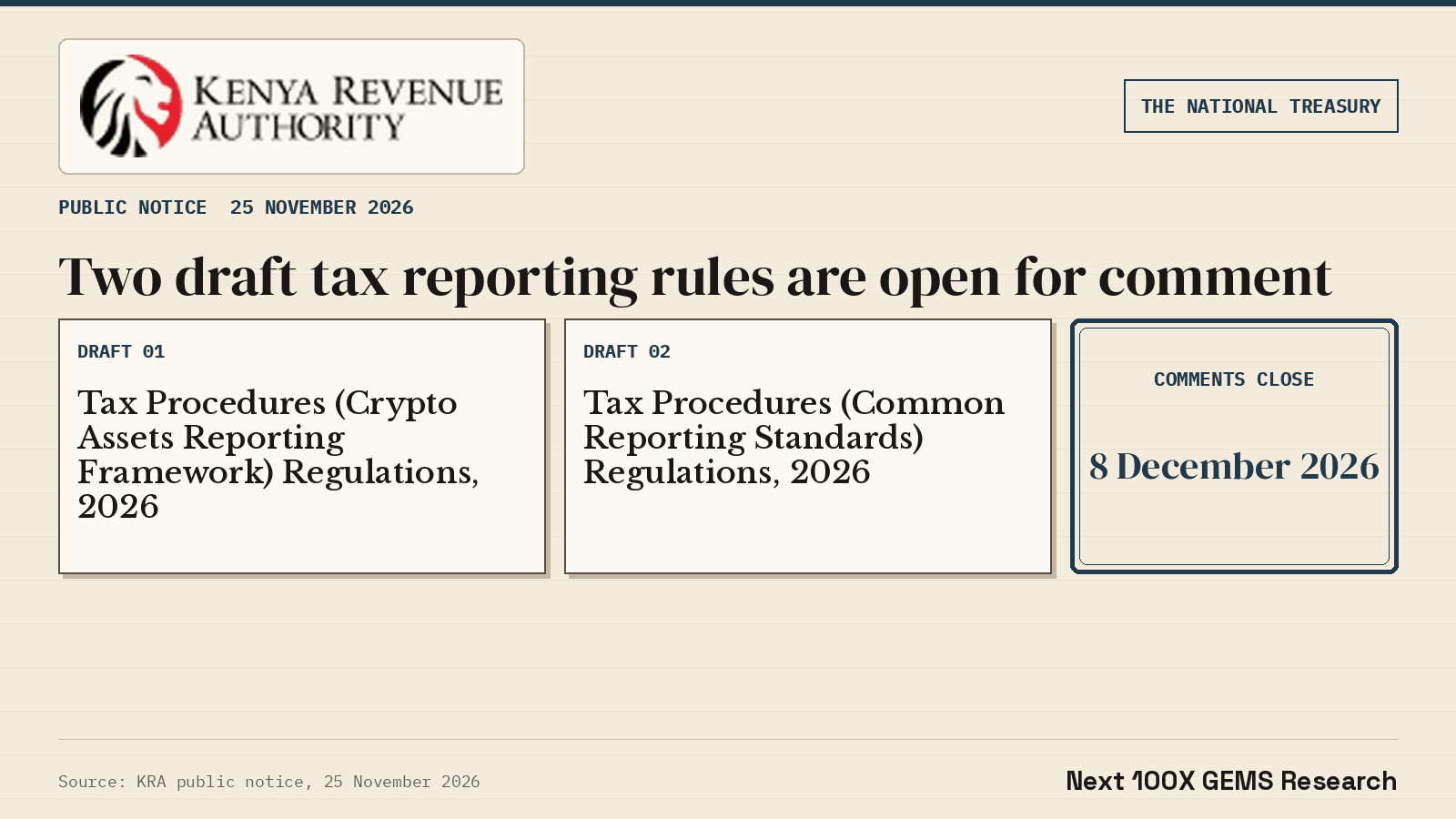
Kenya is asking for comments on two draft regulations that would pull crypto-asset platforms into tax reporting. The Kenya Revenue Authority (KRA) posted them on 25 November, acting for the Cabinet Secretary for the National Treasury under the Statutory Instruments Act, Cap. 2A. They are drafts, with no force until they are made. The crypto draft sets no commencement date and no penalty schedule.
The first is cited as the Tax Procedures (Crypto Assets Reporting Framework) Regulations, 2026, Kenya's version of the OECD Crypto-Asset Reporting Framework, or CARF. The second is cited as the Tax Procedures (Common Reporting Standards) Regulations, 2026, and would replace Kenya's 2023 common-reporting rules. The KRA notice shortens those titles to "Crypto Asset Framework" and "Common Reporting Standard". Both sit under the Tax Procedures Act (Cap. 469B): the crypto draft cites section 112, the CRS draft section 6B(6). Each is signed by John Mbadi Ng'ongo, Cabinet Secretary for the National Treasury, with the "Made on" date left blank. Comments must reach the Commissioner General on or before 8 December, by post to P.O Box 48240-00100, Nairobi, or by email to stakeholder.engagement@kra.go.ke.
Who would have to report
A "Reporting Crypto Asset Service Provider" is any individual or entity that, as a business, effectuates exchange transactions for or on behalf of customers, including as a counterparty or intermediary, or by making available a trading platform.
That provider is subject to the Kenya reporting and due-diligence rules if it is an entity or individual resident for tax purposes in Kenya; an entity incorporated under Kenyan law that either has legal personality in Kenya or must file tax returns or tax information returns there; an entity managed from Kenya; or an entity or individual with a regular place of business in Kenya. A provider is also covered, for the relevant transactions it carries out, through a branch based in Kenya. If the same work is completed under equivalent rules in a "Partner Jurisdiction", a jurisdiction with equivalent legal requirements named on a list published by the Commissioner, the provider may not have to repeat it in Kenya. No such list appears in the draft itself.
What would go to the Commissioner
For each calendar year, a reporting provider would send the Commissioner, for each reportable user and entity with reportable controlling persons, its own name, address and TIN, plus the user's identity, residences and TINs. For individuals that includes date and place of birth. For entities it includes each reportable controlling person. Control of a legal entity includes a 10% ownership interest.
For each type of relevant crypto-asset, the return would give aggregates, in amounts, units and transaction counts, covering fiat and crypto-to-crypto acquisitions and disposals, reportable retail payments, other transfers in and out, and transfers to wallet addresses not known to be associated with a crypto-asset service provider or a financial institution. A reportable retail payment is a transfer for goods or services exceeding USD 50,000. The merchant and the merchant's customer are both treated as users. Transfers below that threshold are still included with ordinary transfers. CBDCs, specified electronic money products, and any crypto-asset the provider has adequately determined cannot be used for payment or investment purposes are excluded.
New users would give a signed or positively affirmed, dated self-certification at onboarding, with name, address, tax residence or residences, and TIN. For pre-existing users, a relationship in place as of 31 December 2026, that certification is due by 12 months after 1 January 2027. The entity-user clause writes "1 January year 2027", a typographical slip; the individual-user clause says "1st January, 2027". A certification that fails a reasonableness check must be replaced, or explained with documentation, before further relevant transactions. Records must be kept for not less than five years after the end of the reporting period, including if the provider is liquidated.
The crypto draft says only "for each calendar year" and sets no filing day. The companion CRS draft requires information returns not later than 31 May of the following year, including a "nil" return if there are no reportable accounts, and would revoke the Tax Procedures (Common Reporting Standard) Regulations, 2023 (L.N. 8/2023).
Does this apply to my exchange account?
It can, if the platform you use is a reporting crypto-asset service provider with one of the Kenya links in regulation 4, or if your activity goes through a Kenya-based branch of such a provider. The platform, not you, would collect the self-certification and report you if you are a reportable user, or if you control an entity that is. A person who only holds crypto-assets in a personal wallet, and never transacts through a covered provider, is not given a reporting duty by this draft. A covered platform would still report, as a separate aggregate, transfers to a wallet address it does not know to be tied to another provider or financial institution.
Spain has given its financial-intelligence unit a power to suspend crypto, bank and payment accounts without a court order. Ukraine has passed a virtual-asset licensing and tax bill that still needs a presidential signature. Hong Kong is advancing a Virtual Asset Services Bill and an SFC licence.
Kenya on the OECD timetable: our count
We counted the names on the OECD Global Forum list of CARF commitments dated 14 September 2026. On that list, 46 jurisdictions have committed to first exchanges by 2027, 27 by 2028, and 4 by 2029. Kenya is in the 2028 group. Those figures are our count, and they match the totals printed on the list.
| Point | Kenya crypto draft | Kenya CRS draft |
|---|---|---|
| Filing day | Not stated | 31 May of the following year |
| Record keeping | Five years after the reporting period | Five years after that period |
| Commencement | "Made on" date blank | Dating line blank; revokes L.N. 8/2023 |
The crypto draft's USD 50,000 retail-payment threshold matches the OECD CARF model. A 2028 first-exchange year generally means a 2027 reporting year, and the draft's 31 December 2026 pre-existing-user cut-off fits that pattern.
What the crypto draft does not say
The crypto draft contains no penalty, fine or offence clause, and no commencement clause. We did not import either from the Tax Procedures Act or the OECD timetable. Until the Cabinet Secretary makes the regulations, the duties described here are a proposal.
Sources
- KRA public notice, "The draft Tax Procedures (Common Reporting Standard) Regulations 2026 and the draft The Tax Procedures (Crypto Asset Framework) Regulations 2026", 25 November 2026
- Draft Tax Procedures (Crypto Assets Reporting Framework) Regulations, 2026, PDF, KRA
- Draft Tax Procedures (Common Reporting Standards) Regulations, 2026, PDF, KRA
- OECD Global Forum, jurisdictions committed to implement the Crypto-Asset Reporting Framework, last update 14 September 2026, PDF
Next 100X GEMS Research
The research desk at Next 100X GEMS. Stories name the document they rely on, and a sponsored post is labeled as paid.
How the desk sources stories