
Hong Kong's new crypto bill: who will need an SFC licence for dealing, advice, management and custody
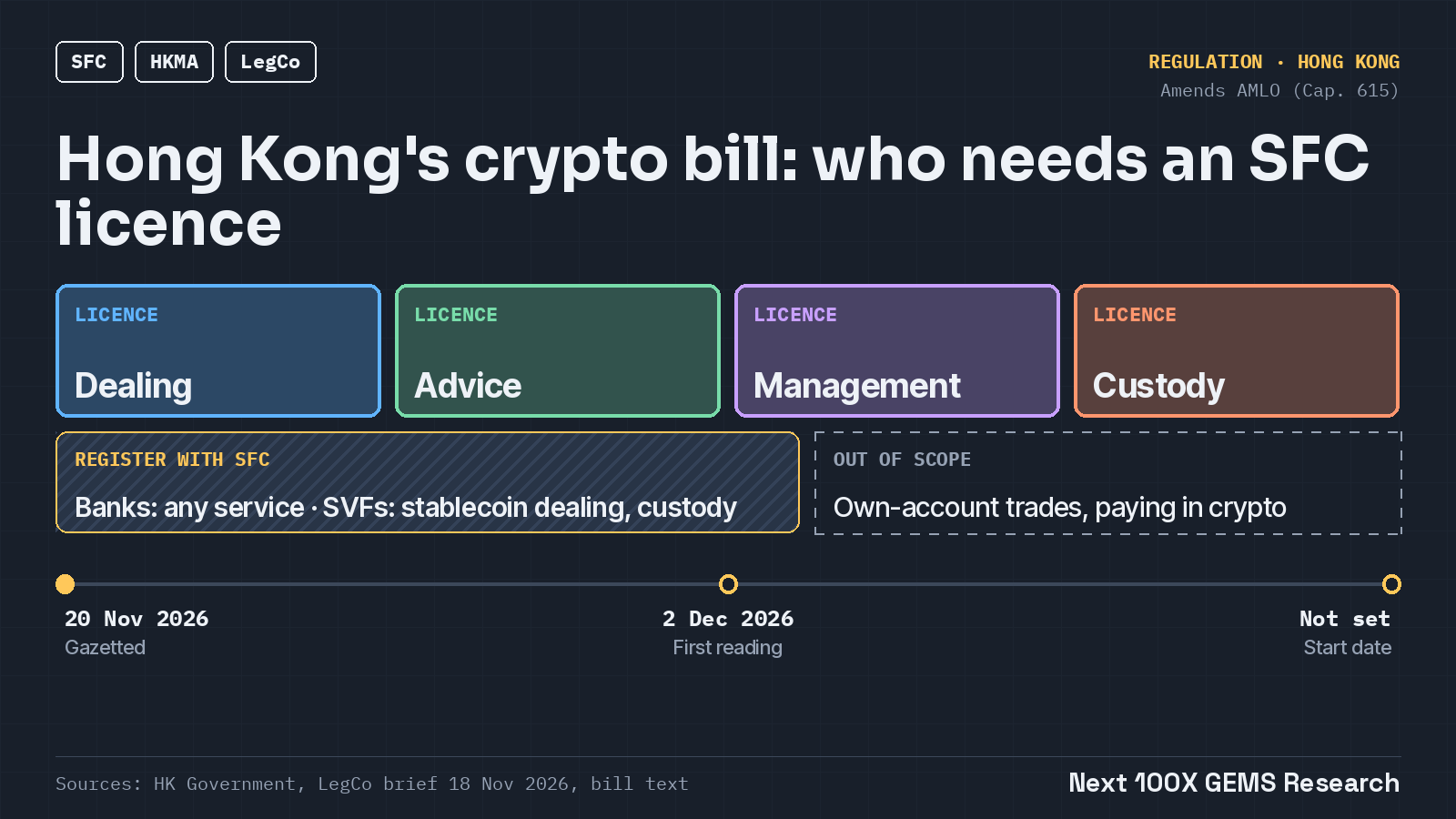
Hong Kong gazetted a bill on 20 November that would make crypto dealers, advisers, managers and custodians get an SFC licence, and banks register. It isn't law yet, there's no start date, and existing firms get no grace licence.

If you run a crypto business that deals, advises, manages money or holds keys for clients in Hong Kong, this bill is about you. If you just buy and hold for yourself, it isn't, though it will change who you can use.
The Virtual Asset Services Legislation (Amendment) Bill 2026 was published in the Gazette on 20 November 2026. It amends the Anti-Money Laundering and Counter-Terrorist Financing Ordinance (Cap. 615), the law that already licenses crypto trading platforms. Anyone carrying on a business of virtual asset dealing, advisory, management or custody services in Hong Kong would have to be licensed by or registered with the Securities and Futures Commission (SFC), unless an exemption applies, and pass a fit-and-proper test. It isn't law yet. It goes to the Legislative Council for first reading on 2 December, and no start date has been set.
Who's in, who's out
This follows the bill text and the government's Legislative Council brief of 18 November.
| If you... | Under the bill |
|---|---|
| Make or offer deals to buy or sell crypto for others as a business, including conversion services | Dealing licence |
| Advise on whether, which, when or on what terms to buy or sell, or issue analyses or reports to help clients decide | Advisory licence |
| Manage a portfolio that holds any crypto for someone else, fund or mandate, with no minimum size | Management licence |
| Safekeep private keys, key parts or similar credentials that can move a client's crypto | Custody licence |
| Are a bank or other authorized institution | Register with the SFC for any of the four |
| Are a stored value facility licensee | Register; the HKMA expects dealing or custody only, in licensed stablecoins |
And out of scope, on the same documents:
- Buying or selling as principal, for your own account, subject to conditions.
- Paying for goods or services in crypto, or accepting it.
- Distributing mining or validator rewards.
- Custody done only for wholly owned group companies, or wholly incidentally by lawyers, accountants, executors or liquidators.
- A licensed stablecoin issuer holding the coins it issued.
- Bank vaults that store devices but can't touch the keys.
- Generic factual information about crypto, and advice published in newspapers, books or broadcasts made generally available to the public.
- Tokenised securities and futures, which stay under the Securities and Futures Ordinance.
The custody line, and the two-key question
The bill defines virtual asset custody as "safekeeping for another person (principal) an instrument that enables the transfer of the virtual asset." That covers a private key, part of one, or any password, code, credential or encrypted seed that lets someone move the asset.
The test is what you can actually do, not what a contract says. You count as safekeeping if you can, alone or with others, move the asset and lock others out of moving it. If someone else in the arrangement can move it alone, you don't. So holding one share of a multi-signature setup can count, as long as nobody else can move the coins without you.
The consultation conclusions of December 2025 drew the same line for funds and trusts. Trustees and fund managers who hand custody to a third-party custodian don't need a custody licence. A firm that can unilaterally move client crypto does.
No grace licence
This is the detail that matters most to anyone already operating. The FSTB and SFC conclusions on dealing and custody, published 24 December 2025, and on advisory and management, published in May 2026, say there will be no deeming arrangement for existing providers. The 18 November brief repeats it: the regime takes "full effect on the commencement date."
There's no interim licence for firms that apply in time. On day one you hold a licence or registration, or you stop. The government says it will pick that day with the time firms need to adjust in mind, and it wants providers to start pre-application talks with the SFC, or the Hong Kong Monetary Authority (HKMA) for banks, now. The custody conclusions promise a faster route for some, such as custody arms of licensed trading platforms and banks already assessed by either regulator.
Banks and stored value facilities
Banks don't get a pass. Under the bill, an authorized institution applies to the SFC to be registered for one or more of the services. The SFC must send each application to the HKMA, which advises whether the applicant is fit and proper. The SFC decides and may rely on that advice. Once they're registered, the HKMA supervises them day to day, while the SFC sets the standards for everyone. The HKMA expects stored value facility licensees to offer only dealing and custody, and only for stablecoins issued under a Hong Kong stablecoin licence.
What changes for users
Nothing today. Once the regime starts, the practical change is who is allowed to serve you.
- Firms providing these services in Hong Kong would need a licence or registration, and the brief proposes making it an offence to actively market them to the Hong Kong public without one, from inside Hong Kong or elsewhere.
- Licensed dealers would have to keep client crypto with a licensed or registered custodian in Hong Kong, with client assets segregated.
- Providers would have to check your crypto knowledge, profile your risk and test suitability, much as securities brokers do.
- Titles such as "crypto dealer" and "virtual asset custodian" would be off limits to anyone without a licence.
For a US contrast, where custody can sit under a bank charter, see our piece on MoonPay's national trust charter.
The path to law
The bill was gazetted on 20 November. On 2 December it gets its first reading, and the second reading debate opens. The rest is marked "to be notified": the resumed debate, the committee stage and the third reading. LegCo's bills database lists no bills committee yet.
If it passes, the ordinance comes into operation on a day the Secretary for Financial Services and the Treasury appoints by notice in the Gazette. The SFC also plans to consult on the detailed codes and guidelines once the legislative work is done. Until then, the trading-platform regime from June 2023 and the stablecoin regime from August 2025 are what's in force.
Sources
- Hong Kong Government press release, "Virtual Asset Services Legislation (Amendment) Bill 2026 gazetted", 20 Nov 2026: https://www.info.gov.hk/gia/general/202611/20/P2026112000582.htm
- Virtual Asset Services Legislation (Amendment) Bill 2026, as published for LegCo, gazetted 20 Nov 2026: https://www.legco.gov.hk/yr2026/english/bills/b202611201.pdf
- FSTB, Legislative Council Brief, File Ref B&M/4/1/41C, 18 Nov 2026: https://www.fstb.gov.hk/fsb/en/legco/docs/bm4141c_20261118-e.pdf
- FSTB and SFC, Consultation Conclusions on VA custodian services, Dec 2025: https://www.fstb.gov.hk/fsb/en/publication/consult/doc/Custodian_consultation_conclusion_e.pdf
- FSTB and SFC, Consultation Conclusions on VA dealing and further consultation on advisory and management, Dec 2025: https://www.fstb.gov.hk/fsb/en/publication/consult/doc/VAdealing_consultation_conclusion_e.pdf
- FSTB and SFC, Consultation Conclusions on VA advisory and management, May 2026: https://www.fstb.gov.hk/fsb/en/publication/consult/doc/VASPVAMSP_consultation_conclusion_e.pdf
- Hong Kong Government press release on the dealing and custody conclusions, 24 Dec 2025: https://www.info.gov.hk/gia/general/202512/24/P2025122400265.htm
- Gibson Dunn client alert on the dealing and custody conclusions, Jan 2026 (secondary): https://www.gibsondunn.com/hong-kong-concludes-consultations-on-regulation-of-virtual-asset-dealing-and-custodian-services-with-yet-more-to-come/
- Altcoin Reporter, 21 Nov 2026 (secondary): https://altcoinreporter.com/hong-kong-gazettes-va-licensing-bill/
Next 100X GEMS Research
A crypto community active since 2021, focused on helping newcomers spot scams and understand the market.
How we work