
Real Decreto-ley 44/2026 lets Sepblac suspend crypto accounts for 5 business days without a judge
A consumer-credit decree published on 25 November adds Article 46 bis to Spain's anti-money-laundering law. From 25 January 2027, Sepblac could suspend a crypto, bank or payment account for up to five business days on its own judgment. Only a judge, asked by a prosecutor, could extend it.

Spain's financial intelligence unit is getting a suspension power that until now worked only on foreign request. Real Decreto-ley 44/2026 of 24 November, published in the Boletín Oficial del Estado (BOE) on 25 November, is mostly about consumer credit and the sale of bad loans. Its sixth final provision adds a new Article 46 bis to Ley 10/2010, the law on preventing money laundering and terrorist financing.
The short version: when Sepblac, the executive service of Spain's anti-money-laundering commission, sees indications that an account or business relationship could be related to money laundering or terrorist financing, it may suspend it for up to five business days without asking a court. It is a suspension, not a seizure. The funds stay where they are while Sepblac looks.
What Article 46 bis says
The article has six paragraphs.
- Paragraph 1 sets the trigger: indications, "a juicio del Servicio Ejecutivo", in Sepblac's own judgment. It can suspend or refuse to authorise a transaction in progress, the use of an account, or a business relationship. The purpose is to preserve the funds, check the suspicion and, if it holds, pass the file to the competent authorities.
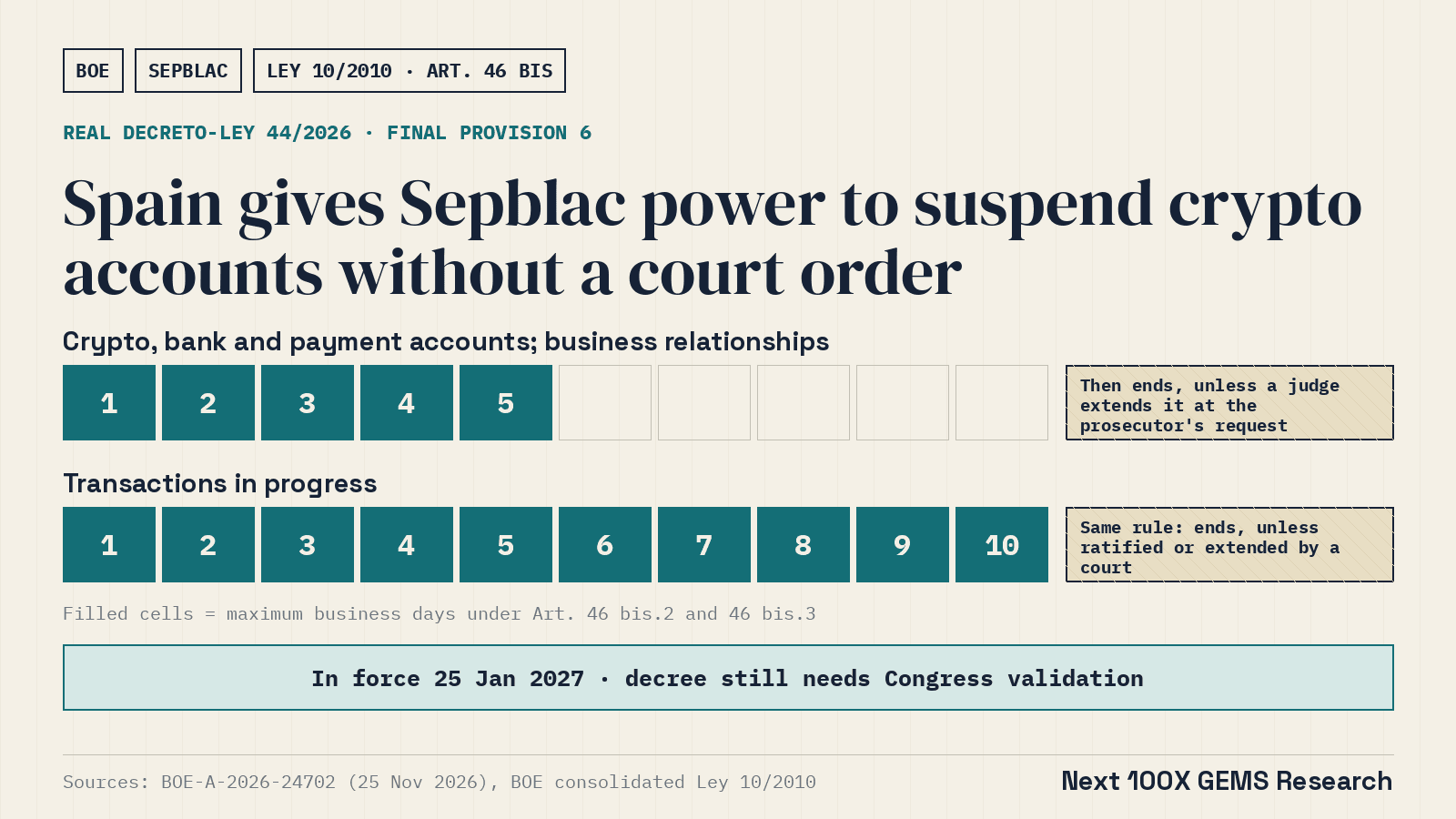
- Paragraph 2 covers transactions in progress: up to ten business days. If the suspicion comes from a suspicious-activity report filed under Article 19, Sepblac must issue the order within three business days of that report.
- Paragraph 3 covers "cuentas bancarias, de pago o de criptoactivos" and business relationships: up to five business days. Both limits are maximums, and a suspension must be lifted early once it is no longer needed.
- Paragraph 4 says what happens at the limit. The suspension ends unless a court ratifies or extends it at the request of the Ministerio Fiscal, the public prosecutor, who must ask before the deadline. Appeals against that court decision follow the Criminal Procedure Act.
- Paragraph 5 shields Sepblac, its staff and firms carrying out an order from liability.
- Paragraph 6 lets Spanish police forces, or another country's financial intelligence unit, request a suspension, "bajo la responsabilidad de la parte solicitante" (on the requester's responsibility).
The decree also deletes Article 48 bis.6, the old foreign-request route, and rewrites Article 51.1(g): failing to comply with a Sepblac suspension becomes a very serious infringement, the law's top penalty tier.
Can Sepblac freeze my exchange account?
Once the article is in force, yes, if the account is held with a firm covered by Ley 10/2010 and Sepblac sees indications of money laundering or terrorist financing. Article 2.1(z) lists crypto-asset service providers, defined by reference to MiCA, the EU's crypto rulebook, as obliged entities. The same article covers non-resident firms doing that business in Spain through branches, intermediaries or cross-border services. Banks and payment institutions were already covered.
Nothing in the text requires a judge for the first five business days. Anything longer needs a prosecutor and a court, which the preamble presents as the safeguard: the reform "prevé la intervención del Ministerio Fiscal y de la autoridad judicial."
We found nothing in the article or the consolidated law on whether the account holder must be told, how often the same account can be suspended, or how a holder can challenge the first five days. Those points may come in regulations or practice.
How many crypto firms it could reach: our count
We counted the entries in ESMA's interim MiCA register of crypto-asset service providers (file CASPS.csv, last updated 18 November 2026, downloaded 27 November). Of 407 active entries, 17 are authorised in Spain by the CNMV. Another 200, authorised in other EU states, list Spain among the countries they have notified for cross-border services. That gives 217 providers on the register that can serve Spanish clients, about 53% of the active entries.
The Spanish 17 include BBVA, CaixaBank and Openbank as well as Bit2Me and Criptan. The largest groups of passporting firms come from France (29), the Netherlands (21) and Cyprus (20). This counts who could be asked to comply, not how often Sepblac will act.
Why it arrived in a credit decree
The preamble cites the Financial Action Task Force (GAFI in Spanish), which expects financial intelligence units to be able to suspend suspicious transactions. It calls the current limit "una deficiencia" that the FATF will assess, and says the aim is that fast transfers do not make later investigations useless. The change had been part of a broader draft anti-money-laundering law whose consultation closed on 30 September.
The dates that matter
| Date | Step | Source |
|---|---|---|
| 24 Nov 2026 | Decree-law adopted | BOE text |
| 25 Nov 2026 | Published in BOE No. 293 | BOE |
| 26 Nov 2026 | Diputación Permanente votes on five other decrees, not this one | Criptoinforme, citing El Plural |
| 29 Nov 2026 | General election | Criptoinforme |
| 25 Jan 2027 | Article 46 bis in force, per the BOE consolidated text | BOE |
The decree enters into force "a los dos meses de su publicación", and the Ley 10/2010 changes are not among its exceptions. The BOE's consolidated Ley 10/2010 marks Article 46 bis "No vigente aún", in force from 25 January 2027.
Under Article 86 of the Constitution, a decree-law must be put to Congress within 30 days of its promulgation to be validated or repealed. With the Cortes dissolved for the election, that vote falls to the Diputación Permanente, and Criptoinforme, citing El Plural, reported on 26 November that the 24 November decrees would not reach it until after the election, with no date set. Validation is one yes or no on the whole decree. AEFI, AEMIP and Adigital, three fintech and payments associations, have asked that it not be validated over its credit-cost caps, without mentioning Sepblac or crypto, Criptoinforme reported. If the decree falls, Article 46 bis falls with it.
Other governments are moving on crypto firms through their own statutes, from Ukraine's Bill 10225-d on virtual-asset licensing and tax to Hong Kong's Virtual Asset Services Bill and its SFC licence. For a US contrast, FinCEN used a special measure, not a suspension, in its order cutting MEXC off from US transfers.
Sources
- BOE, Real Decreto-ley 44/2026, de 24 de noviembre (BOE-A-2026-24702), PDF, 25 Nov 2026
- BOE, Real Decreto-ley 44/2026, HTML text
- BOE, Ley 10/2010, de 28 de abril, consolidated text (last update published 25 Nov 2026)
- BOE, Constitución Española, Article 86
- ESMA, interim MiCA register of crypto-asset service providers, CASPS.csv (last updated 18 Nov 2026, downloaded 27 Nov 2026)
- Criptoinforme, "Sepblac: congelar cuentas cripto se votará tras el 29-N", 26 Nov 2026
Next 100X GEMS Research
The research desk at Next 100X GEMS. Stories name the document they rely on, and a sponsored post is labeled as paid.
How the desk sources stories