
MoonPay applies for a national trust bank: what an OCC trust charter lets a crypto firm do
MoonPay has asked the OCC for a charter to open MoonPay National Trust Bank. It is an application, not an approval. Here is what this kind of bank can and can't do, and how far the other crypto applicants have got.

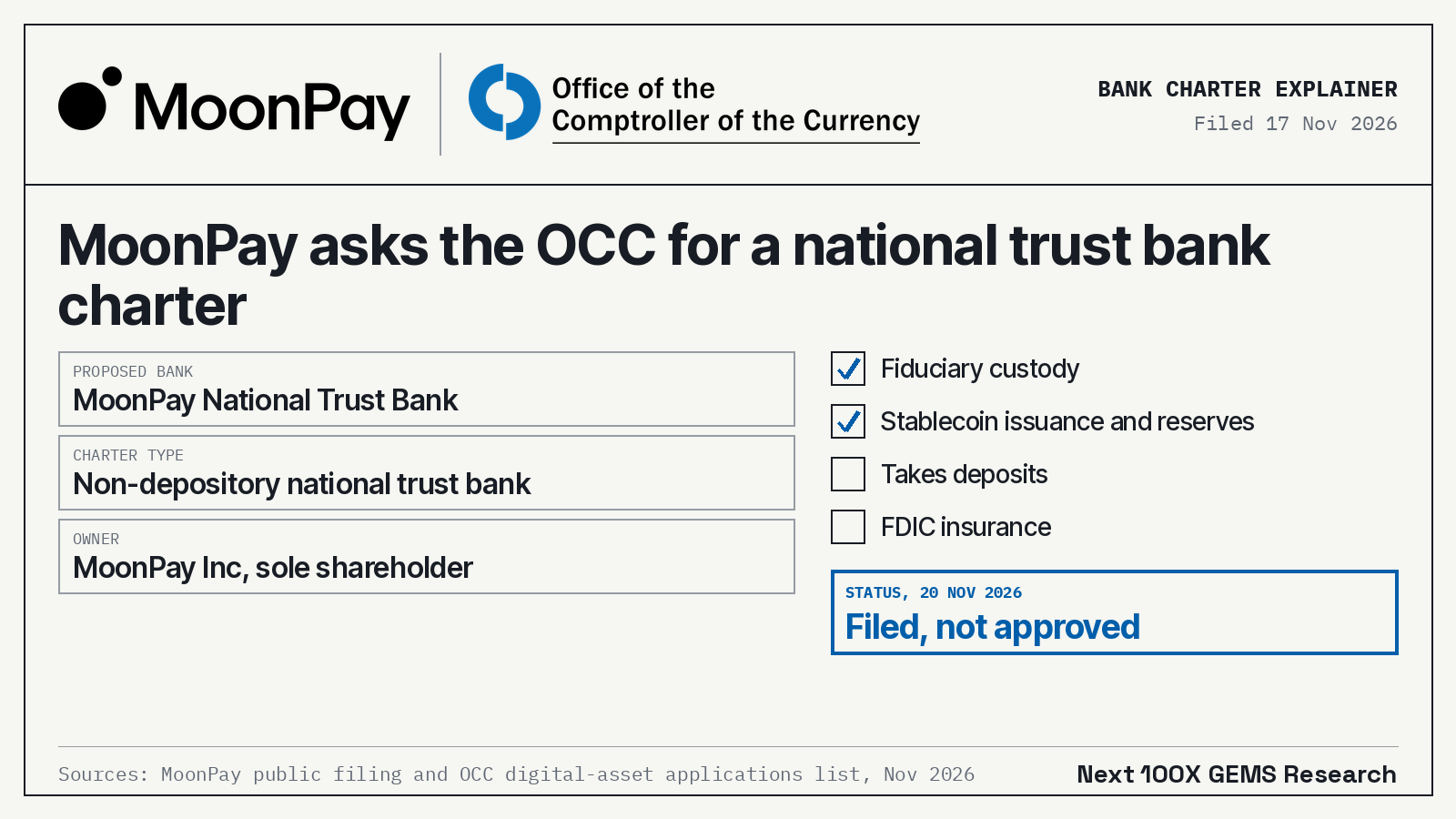
MoonPay applied on 17 November to the Office of the Comptroller of the Currency, the federal regulator for national banks, for a charter to open MoonPay National Trust Bank. The OCC logged it as received on 18 November. If granted, the charter would let MoonPay hold digital assets for clients as a fiduciary, issue and redeem stablecoins, manage their reserves and convert assets on clients' behalf, all under federal supervision. It would not let MoonPay take deposits, and the bank would have no FDIC insurance. And for now none of this is allowed: a filing is a request, and the OCC has decided nothing.
What the charter would let MoonPay do
A national trust bank is a real bank in the legal sense, chartered and examined by the OCC, but a narrow one. MoonPay's public filing describes a "non-depository national bank" whose operations "will be limited to those of a trust company and activities related thereto." It lists the three business lines named above: fiduciary custody, stablecoin services including issuance, redemption and reserve management, and conversion services carried out on clients' behalf.
Fiduciary custody is the core. It means the bank holds assets on a client's behalf and owes that client legal duties of care, under one federal rulebook instead of state-by-state licences. The stablecoin piece matters because of timing. The GENIUS Act, the US stablecoin law, takes effect on 18 January 2027, Cointelegraph notes, and a federally chartered issuer would sit inside that framework.
MoonPay Inc, the parent company, would own the bank outright. In the filing, MoonPay says it has more than 30 million customers in 180 countries; that is its own figure.
What it wouldn't let MoonPay do
The filing ticks "no insurance sought," and it calls the bank non-depository. In plain terms, it can't take deposits the way an ordinary bank does, and nothing held there would carry FDIC deposit insurance. Cointelegraph reports the bank also wouldn't make loans.
The OCC's letter to Coinbase shows how tightly that line is drawn once a charter is granted. Coinbase's trust bank must keep to "those of a trust company and activities related thereto, as specifically stated in the business plan," and must not become a "bank" under the Bank Holding Company Act. Any significant change to its products, including new transactional services for custody clients, needs 60 days' notice and a written no-objection from the OCC. A trust charter is a box, and the regulator holds the lid.
From filing to opening
The public notice in MoonPay's filing gives anyone 30 days from publication to send written comments, with the end date posted in the OCC Weekly Bulletin. After that the OCC reviews the application, much of which MoonPay has asked to keep confidential, including its business plan.
Coinbase's charter shows the rest of the path. Its OCC control number dates the application to 2025. The OCC granted preliminary conditional approval on 2 April 2026, which allowed Coinbase to organise the bank but not to open it. On 6 November the OCC granted final conditional approval and authorised the bank to open on 9 November.
That final letter came with conditions for the first three years. The bank must hold at least $60 million in tier 1 capital, with the greater of half of that or $30 million in eligible liquid assets, plus a separate 180 days of operating expenses. It must adjust its activities to the GENIUS Act and the OCC's rules as they take effect. New directors and senior officers need an OCC no-objection first. Coinbase's April letter also notes it will move its custody business from a New York state trust company to the new bank over that three-year period.
None of this tells us how long MoonPay will wait or what conditions it would face. Each approval is its own decision.
Where the other crypto applicants stand
MoonPay now tops the OCC's public list of pending digital-asset licensing applications. As of 20 November the list had 15 entries, including Galaxy National Bank (received 26 October), Ramp National Trust Bank (19 October), Rain National Trust Bank (5 October), Modern Treasury National Trust Bank (1 October), zerohash national trust bank (19 August) and Payward National Trust Company (8 May), Payward being Kraken's parent. Every name on it is still waiting.
Some firms are further along. Coinbase's trust bank opened this month, and Circle received final OCC approval in July, according to Cointelegraph. Not everyone welcomes the trend. Cointelegraph reports that the Independent Community Bankers of America sued the OCC in October, arguing it overstepped by letting non-depository trust banks do work traditionally done by commercial banks.
MoonPay hadn't published its own statement on the filing as of 20 November. For another case of a regulator's approval arriving before any product, see our piece on Backpack's CFTC approvals.
Sources
- OCC digital assets licensing applications: https://www.occ.gov/topics/charters-and-licensing/digital-assets-licensing-applications/index-digital-assets-licensing-applications.html
- MoonPay National Trust Bank public filing (PDF): https://www.occ.gov/topics/charters-and-licensing/digital-assets-licensing-applications/moonpay-national-trust-bank-combined-cv-pa.pdf
- OCC Corporate Decision 1370, Coinbase National Trust Company, including the 6 Nov 2026 final approval (PDF): https://www.occ.gov/topics/charters-and-licensing/interpretations-and-decisions/2026/cd1370.pdf
- Cointelegraph: https://cointelegraph.com/news/moonpay-seeks-us-bank-charter-for-stablecoin-custody-services
- Bloomberg Law: https://news.bloomberglaw.com/banking-law/crypto-payments-firm-moonpay-applies-for-bank-charter
Next 100X GEMS Research
A crypto community active since 2021, focused on helping newcomers spot scams and understand the market.
How we work