S&P keeps Tether's USDT at 5: what the 28% riskier-reserves figure actually means
S&P Global Ratings left USDT at 5, the bottom of its stablecoin stability scale, on 18 November. The headline number is that riskier assets now equal 28% of tokens in circulation. Here is what that score measures, and how big a fall the reserve cushion in Tether's own 30 September report can absorb.

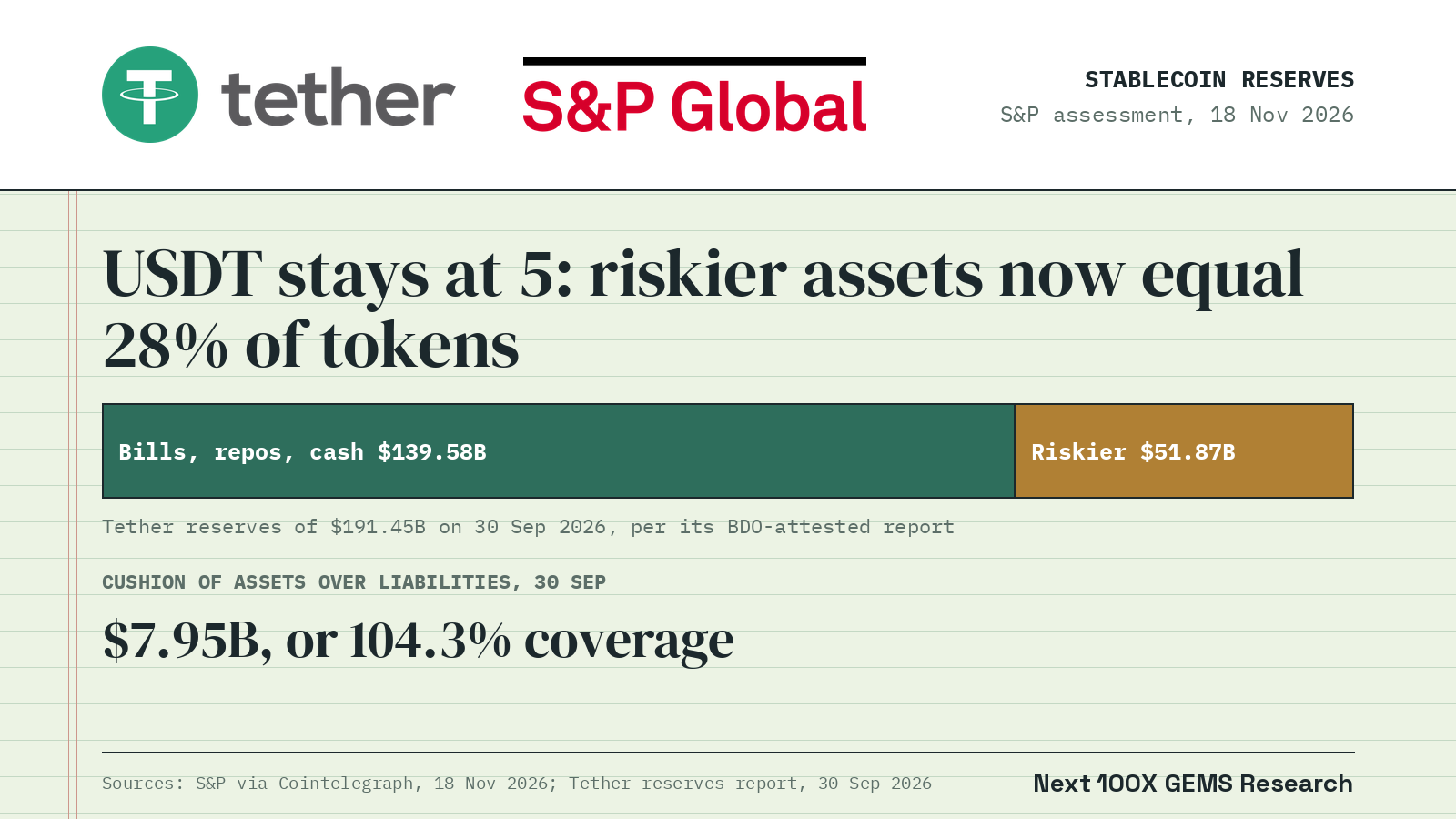
S&P Global Ratings kept Tether's USDT at 5, or "weak", on 18 November, the lowest score on its five-point stablecoin stability scale and the same score it gave in November 2025. The number behind the headline is that assets S&P treats as higher risk, such as gold, bitcoin, public equities, secured loans and corporate bonds, were equal to 28% of USDT in circulation on 30 September, up from 24% a year earlier, according to the report as quoted by Cointelegraph. That does not mean 28% of USDT is unbacked. Tether's own attested figures show assets above liabilities by about $7.95 billion. What S&P is pointing at is the size of the riskier pile next to that cushion.
What a 5 measures, and what it doesn't
S&P says its Stablecoin Stability Assessment is not a credit rating. It scores how well a stablecoin can hold its peg, from 1 (very strong) to 5 (weak), and compares stablecoins with each other, not with bonds. The agency starts with the quality of the backing assets, then looks at governance, the legal and regulatory setup, redeemability and liquidity, technology dependencies and track record. Those later factors can only hold the score or pull it down.
That last point shapes how to read this year's result. S&P said it found further weaknesses but made no downward adjustment "because our assessment cannot be lower than 5," Cointelegraph reported. The same report credited USDT with a good record of price stability, particularly over the past 12 months. So the score is a judgment about how exposed the peg could be under stress, not a statement that the peg is failing.
The reserve mix on 30 September
Tether's latest quarterly report, with a reasonable-assurance opinion from BDO, lists every asset category. BDO's opinion covers that single date only.
| Asset, 30 Sep 2026 | US$ billions | Share of total assets |
|---|---|---|
| US Treasury bills | 122.84 | 64.2% |
| Overnight reverse repos | 9.52 | 5.0% |
| Term reverse repos | 7.18 | 3.7% |
| Non-US bills, cash and deposits | 0.04 | under 0.1% |
| Precious metals (gold bars) | 19.08 | 10.0% |
| Secured loans | 14.18 | 7.4% |
| Bitcoin | 8.37 | 4.4% |
| Other investments | 6.00 | 3.1% |
| Public equities | 4.18 | 2.2% |
| Corporate bonds | 0.06 | under 0.1% |
| Total assets | 191.45 | 100% |
| Liabilities | 183.50 | |
| Excess of assets over liabilities | 7.95 |
Add up the six categories from gold downward and you get about $51.87 billion, or 28.3% of the $183.47 billion of tokens issued. That is our sum, and it lines up with S&P's 28%. S&P also tracked the shifts within it: gold up to about $19 billion from $12.9 billion a year earlier, bitcoin down to $8.4 billion from $9.9 billion, and $4.2 billion of public equities that were not there before. Treasury bills and overnight repos, which S&P counts as low risk, came to 72% of circulation, down from 75%, per The Crypto Times.
The arithmetic of the cushion
Here is the simplest way to see S&P's concern, using only the 30 September figures. The cushion is $7.95 billion. The riskier assets total $51.87 billion. If every one of them lost value at once, a fall of about 15.3% would use up the cushion.
A narrower example. Bitcoin and gold together were $27.45 billion, valued at the closing prices BDO used for that date, $83,621.23 per bitcoin and $4,157.41 per ounce of gold. A 20% drop in both, with nothing else moving, would cost about $5.49 billion. The cushion would shrink to about $2.46 billion and the ratio of assets to liabilities would fall from 104.3% to about 101.3%. It would take a fall of roughly 29% in both to erase the cushion on its own.
This is arithmetic on one date, not a forecast. Prices have moved since 30 September, and we have not repriced them. Tether also reported $1.5 billion of net operating profit in the third quarter, which adds to the cushion over time. The secured loans are carried at amortised cost and described as over-collateralised with margin calls, so they would not move like a market price.
What S&P wants to see
Much of the report is about disclosure rather than assets. Per Cointelegraph and TokenPost, S&P noted that KPMG issued an unqualified opinion on Tether's 2025 accounts but that the audited statements and auditor's report are not public. The reserve reports do not name custodians or counterparties, and they give little detail on the credit quality of the secured loans and corporate bonds. Attestations are quarterly while other stablecoins generally report monthly. S&P also said El Salvador's rules, under which Tether now operates, require 70% of reserves in assets that can be sold within 30 days but allow assets such as gold and bitcoin, and do not require reserves to be segregated from the company's other assets.
Tether's answer
Tether rejects the framework, not the numbers. "The problem is S&P's framework, not our reserves," the company told Cointelegraph. "Their own history shows the underlying problem," it added, pointing to The Big Short, the film about the 2008 financial crisis. When Tether released its third-quarter report on 30 October, its chief executive, Paolo Ardoino, said generating $1.5 billion of net operating profit while holding nearly $8 billion of excess reserves "gives us a strong foundation," and that the company is building "with the liquidity to meet redemptions." The 30 September figures show a $7.95 billion cushion, which Tether's release says has nearly doubled since June, and a riskier pile several times larger than that cushion.
Sources
- S&P Global stablecoin assessments page: https://www.spglobal.com/ratings/en/products/stablecoin-assessments
- Cointelegraph on the 18 Nov report: https://cointelegraph.com/news/tether-usdt-sp-stability-assessment-reserve-risks
- Tether reserves report with BDO opinion, 30 Sep 2026 (PDF): https://assets.ctfassets.net/vyse88cgwfbl/7nQYtcoP9GxIUFSyro2dGK/8d0521470b9e99c8c0831019cabea4ee/ISAE_3000R_-_Opinion_Tether_International_Financial_Figure_30-09-2026.pdf
- Tether Q3 release: https://tether.io/news/tether-generates-1-5-billion-in-q3-net-operating-profit-as-reserve-buffer-doubles-to-almost-8-billion/
- crypto.news: https://crypto.news/tether-usdt-weakest-stability-score-reserve-risks/
- TokenPost: https://www.tokenpost.com/news/investing/60920
- The Crypto Times: https://www.cryptotimes.io/2026/11/19/sp-keeps-tether-usdt-at-weak-as-riskier-reserves-hit-28/
Next 100X GEMS Research
A crypto community active since 2021, focused on helping newcomers spot scams and understand the market.
How we work