Bitcoin Core CVE-2026-117348: the LLM-found bug that could stall a node with one ID repeated 50,000 times
A peer could make a Bitcoin Core node stop listening for over a dozen seconds at a time by repeating one transaction ID 50,000 times. It's fixed in 30.5, 31.3 and 32.1, no coins were ever at risk, and 29.x won't get a patch.

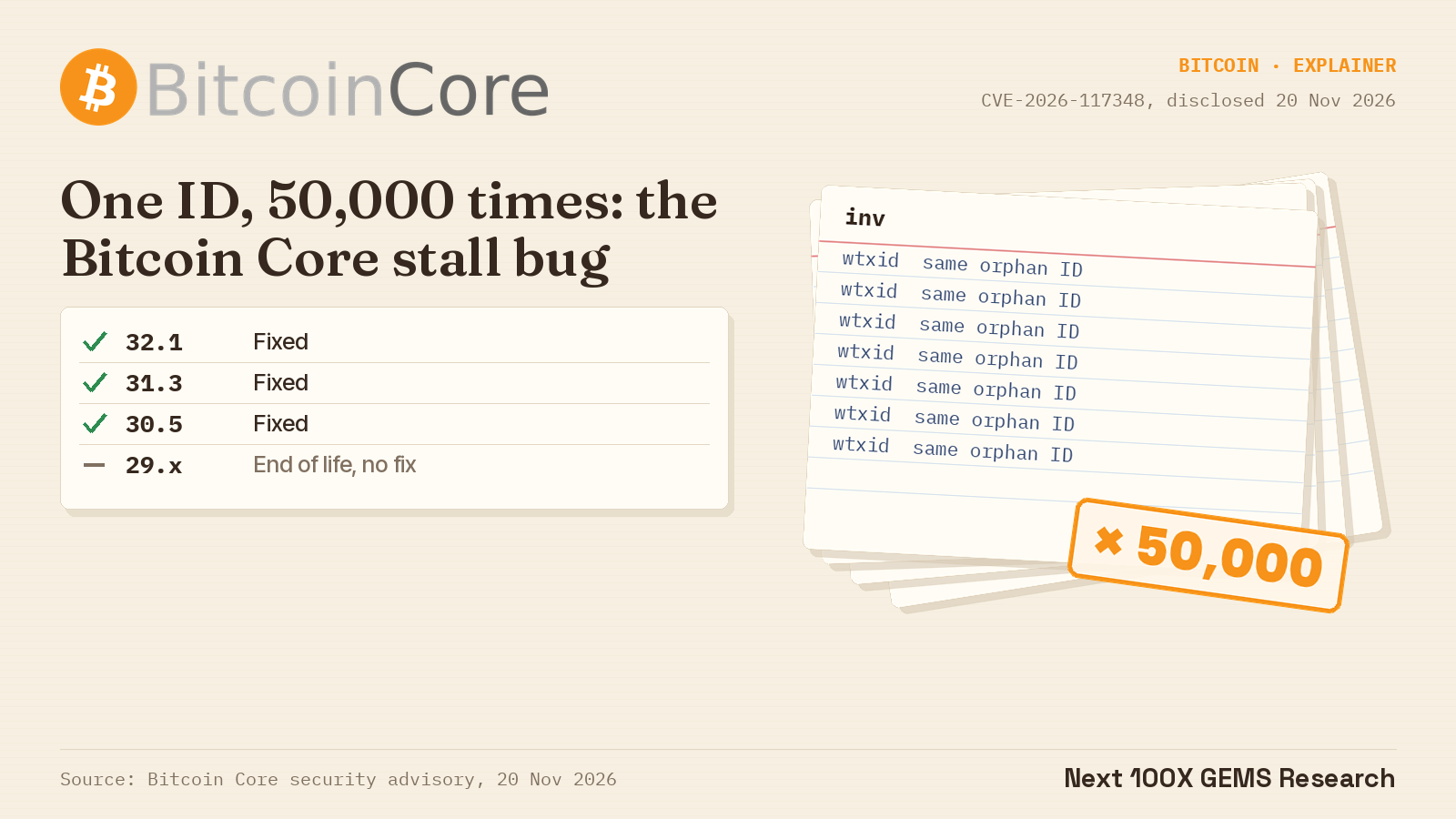
If you run Bitcoin Core 30.5, 31.3 or 32.1, you're already fixed. If you're on anything from 29.0 to 31.2, upgrade. The bug, disclosed on 20 November 2026 as CVE-2026-117348, let a connected peer make a node stop processing for over a dozen seconds at a time, blocks included. It couldn't move or steal anyone's coins. Bitcoin Core rates it Medium severity. The advisory doesn't report it being used against anyone, and we found no reports that it was.
The odd part is how it was found. An automated scan using a large language model flagged it, as part of a Spiral project called Loupe, and a Bitcoin Core developer checked it before it went any further.
A clerk with a very long form
Picture a post office clerk. Someone hands over a parcel that can't be delivered yet, because it's waiting on thousands of other parcels. The clerk files it. Then the same person comes back with a form that lists that one parcel's number 50,000 times and asks, for each line, "have the others turned up?" The clerk dutifully runs through the whole list of thousands, 50,000 times over. Meanwhile the queue doesn't move. The courier with the day's most important delivery stands waiting too.
That's the bug, more or less. The fix is the obvious one: if a number is on the form twice, look it up once.
What actually happened
Nodes tell each other about new transactions with a message called inv, short for inventory. One inv can list up to 50,000 entries.
Sometimes a node hears about a transaction before the transactions it depends on, its parents. Bitcoin Core keeps those in a holding area called the orphanage and asks peers for the missing parents. Since version 29.0, when a peer announces a transaction that's sitting in the orphanage, the node builds the list of its parents and checks each one against its mempool and its record of recently seen transactions.
According to the advisory, duplicates in an inv weren't skipped. So an attacker could first send an orphan with thousands of missing parents, then send inv messages repeating that orphan's ID, its wtxid, 50,000 times. "Each such message stalls the node for over a dozen seconds, during which it processes no messages from other peers, including blocks," the advisory says. Keep sending, and the stall keeps going.
For the node, that's a real problem. It falls behind, and CoinDesk pointed out that an exchange relying on one could be slow to credit deposits. For your coins, it isn't. They live on the blockchain, not inside anyone's node, and nothing here touches the rules about who can spend what.
Is my version affected?
Per Bitcoin Core's advisory of 20 November and its software life cycle page:
| Version | Status | What to do |
|---|---|---|
| 32.1 (released 27 Oct) | Fixed | Nothing |
| 31.3 and 30.5 (released 20 Nov) | Fixed | Nothing |
| 31.0 to 31.2 | Affected | Upgrade to 31.3 or 32.1 |
| 30.0 to 30.4 | Affected | Upgrade to 30.5 or newer |
| 29.0 to 29.5 | Affected, end of life since 27 Oct, no fix | Move to a maintained series |
| 28.x and older | Not listed as affected; end of life | Upgrade anyway |
There's no 32.0 to worry about. It was tagged but never fully released, according to the 32.1 release notes.
If you use an exchange rather than running a node, there's nothing for you to do. It's your exchange's job to keep its nodes patched.
Why the fix came months before the news
The timeline in the advisory runs like this. Loupe reported the issue on 8 July. Someone going by Stutxo reported it separately on 4 August, the same day Gregory Sanders opened the fix, pull request #35878. It was merged on 6 August, with a modest description about avoiding "spurious work." It shipped in 32.1 on 27 October, was backported to the 30.x and 31.x branches on 17 November, and went out in 30.5 and 31.3 on 20 November, the day it was disclosed.
That gap is how Bitcoin Core has long handled security fixes. Under its standard policy, Medium and High bugs stay quiet until two weeks after the last affected release reaches end of life, which the project puts at roughly a year after the fix first ships. People are slow to upgrade the software that checks their money, so the project gives them time before it tells attackers where to look.
On 22 October the project added an exception. Bugs it judges "easily discoverable," the kind that "can be discovered with minimal effort, such as through a simple LLM prompt," now get fixed releases for every maintained version as soon as possible, with the advisory published alongside them. The pull request behind the change cited a rise in reports of bugs that are easy to find or rediscover. The 32.1 notes then said any easily discoverable bugs it fixed would be disclosed once every maintained version had a fix. This one was classed that way. When 30.5 and 31.3 came out, the advisory came with them.
A short, honest note on machine-found bugs
It's tempting to make this a story about machines out-hacking people. It isn't, quite. Loupe flagged the bug, and its makers at Spiral say it only reports findings backed by a working test case. A person, Sanders, confirmed it and took it to the security team. A second person found the same thing on their own about four weeks later. That's partly why it counted as easy to find.
The tools that help defenders find bugs like this help attackers too, and Bitcoin Core's new rule is an admission of that. Shorter quiet periods mean less time for the fix to settle in, but here it was a small one: look at each ID once.
Sources
- Bitcoin Core, "CVE-2026-117348 - Node stall through duplicate orphan announcements", 20 Nov 2026: https://bitcoincore.org/en/2026/11/20/disclose-orphan-inv-stall/
- Bitcoin Core security advisories and disclosure policy (read 22 Nov 2026): https://bitcoincore.org/en/security-advisories/
- Bitcoin Core 31.3 release notes, 20 Nov 2026: https://bitcoincore.org/en/releases/31.3/
- Bitcoin Core 30.5 release notes, 20 Nov 2026: https://bitcoincore.org/en/releases/30.5/
- Bitcoin Core 32.1 release notes, 27 Oct 2026: https://bitcoincore.org/en/releases/32.1/
- Bitcoin Core software life cycle (read 22 Nov 2026): https://bitcoincore.org/en/lifecycle/
- GitHub, bitcoin/bitcoin PR #35878, merged 6 Aug 2026: https://github.com/bitcoin/bitcoin/pull/35878
- GitHub, bitcoincore.org PR #1281, security policy update, merged 22 Oct 2026: https://github.com/bitcoin-core/bitcoincore.org/pull/1281
- Project Loupe, "Meet Loupe", 20 Jul 2026: https://www.projectloupe.org/p/meet-loupe-ai-powered-vulnerability
- Bitcoin Optech podcast recap of Newsletter #429, 3 Nov 2026: https://bitcoinops.org/en/podcast/2026/11/03/
- CoinDesk, 21 Nov 2026: https://www.coindesk.com/markets/2026/11/21/bitcoin-nodes-could-be-stalled-by-repeating-one-id-50-000-times-ai-found-the-bug
- Bitcoin.com News, 21 Nov 2026: https://news.bitcoin.com/security/ai-finds-bitcoin-core-security-flaw-that-could-temporarily-freeze-nodes/
Next 100X GEMS Research
A crypto community active since 2021, focused on helping newcomers spot scams and understand the market.
How we work