
Warren and Van Hollen ask SEC to rescind Regulation Crypto Assets, withdraw tokenized-stock order
In two letters dated 24 November 2026, Senators Elizabeth Warren, Chris Van Hollen and Tina Smith asked SEC Chair Paul Atkins to rescind the proposed Regulation Crypto Assets rule. A second letter, led by Van Hollen and signed by the same three plus Senator Jack Reed, asked him to withdraw the September order on tokenized securities venues. Neither letter sets a date for a reply.

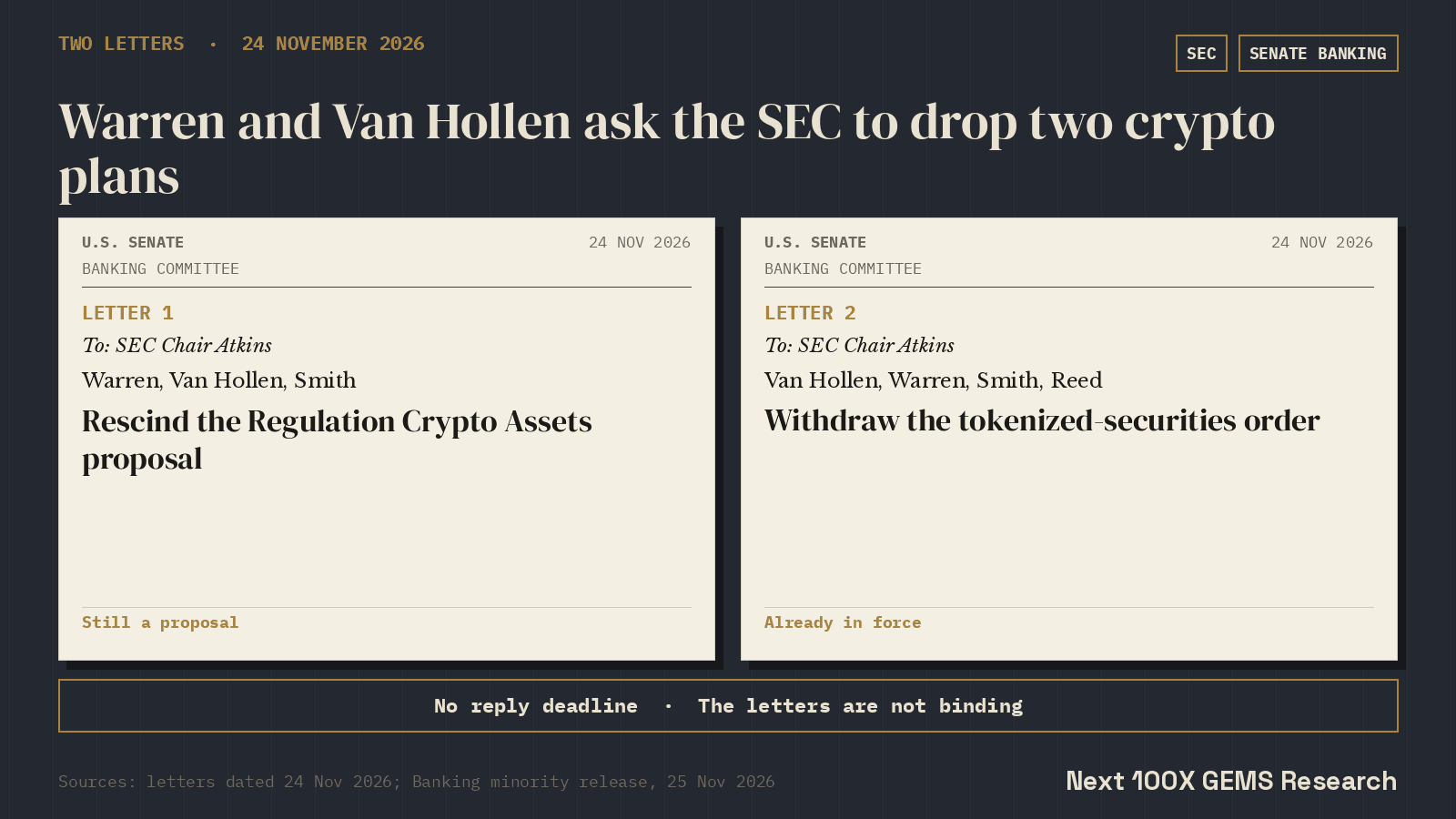
There are two letters, not one, and they aim at two different SEC actions. Both are dated 24 November 2026. The Senate Banking Committee's minority office released them on 25 November. They are requests. They do not, by themselves, cancel a proposal or an order.
The two letters
The first letter is led by Warren, the Banking Committee's ranking member, and signed with Van Hollen and Tina Smith. It urges the Commission to "rescind," "withdraw" and "reconsider" the Regulation Crypto Assets proposal. The letter objects that the proposal would allow offerings with no SEC review, no financial statements in some cases and "scarce disclosure"; that it would block state registration rules; that it exceeds the Commission's authority; and that it undercuts the Supreme Court's test in SEC v. W.J. Howey Co. for when an arrangement is an investment contract.
The second letter, led by Van Hollen and signed with Warren, Smith and Jack Reed, asks Atkins to "withdraw" the September order for Tokenized Securities Venues and certain liquidity providers, or at least to make any change through a public rulemaking. The senators write that the order "would allow TSV platforms to operate a shadow stock market outside longstanding regulatory protections designed to ensure fair and transparent markets." They also say the Commission issued it without the notice-and-comment process required by the Administrative Procedure Act. Neither letter sets a deadline for a reply.
What Regulation Crypto Assets is, and where it stands
Regulation Crypto Assets is still a proposal. The Commission issued it on 18 August 2026, as Release Nos. 33-11434 and 34-106150, File No. S7-2026-27, and published it in the Federal Register on 21 August. The rule page, last reviewed on 17 November, still lists it as proposed, with comments due on 20 October 2026. It has not been adopted.
The Commission's summary describes a "tailored offering regime" for certain investment contracts involving crypto assets, with two exemptions from Securities Act registration and a conditional safe harbor from the term "investment contract." The first exemption would permit offerings of up to $5 million during a four-year period. The second would permit offerings of up to $75 million during each 12-month period.
The senators' letter calls the first facility a "one-time 'startup exemption'" and the second a two-tier "fundraising exemption" for a 12-month period. It says startup issuers would file no financial statements, and that the safe harbor would let an issuer self-certify "with no SEC review or approval" once it believes it has "ceased all essential managerial efforts." The Commission's page does not use "one-time"; it says "during a four-year period." The comment deadline was 20 October, before these letters were sent. The Commission has nonetheless posted the Warren letter in the S7-2026-27 file, dated 24 November.
What the innovation exemption is, and where it stands
The September action is not a proposed rule. It is an order, Release No. 34-106402, File No. 4-927, issued on 17 September 2026 and published in the Federal Register on 22 September. The Commission's press release called it an "Innovation Exemption." It grants temporary, conditional relief to Tokenized Securities Venues from the Exchange Act definition of "exchange," so they can trade tokenized NMS stock through permissioned automated market makers and liquidity pools, and a parallel exemption from the definition of "dealer" to certain liquidity providers. The relief is already in force.
Where an unaffiliated third party tokenizes a stock, the venue must give the issuer written notice. Trading may not start until at least 30 calendar days after the issuer receives that notice, and the issuer may object in writing on or before the 30th calendar day. The order is "set to expire five years after publication."
The second letter calls that five-year term a "theoretical" sunset and says the Commission "may extend the five-year sunset period at anytime, and the order itself directs the Commission to permanently adopt it at the end of the five-year period." In the order we read, the Commission asks for comment on whether the exemption "should be permanent" and whether its length is appropriate. We did not find a clause that directs permanent adoption or allows an extension at will. Those statements are the senators' reading.
The dollar caps, compared with today's rules
We compared the two dollar caps on the SEC's Regulation Crypto Assets rule page, retrieved on 27 November 2026, with the offering limits now in the Electronic Code of Federal Regulations, also retrieved that day. Regulation Crowdfunding, at 17 CFR 227.100(a)(1), limits sales in reliance on Securities Act section 4(a)(6) to $5 million in the 12-month period before a sale. Regulation A Tier 2, at 17 CFR 230.251(a)(2), limits the sum of the aggregate offering price and aggregate sales to $75 million. Those are the same headline amounts as the proposal's exemptions. The structures differ: the Commission's page applies the $5 million cap "during a four-year period," whereas the crowdfunding cap resets over 12 months. The $75 million cap, like Regulation A Tier 2, is a 12-month figure. Our comparison is only of the dollar caps and their time windows. The first letter also argues that the proposed forms would carry less disclosure than comparable offerings, and that unlike Regulation A Tier 1, none of the proposed crypto offerings would face state securities registration as a backstop.
Can senators make the SEC rescind a rule?
No. These letters ask the Chair to act. They do not repeal a proposal, set aside an order, or bind the other commissioners. The Commission can still adopt, amend or drop the proposal, and it can leave the September order in place, modify it, or withdraw it.
That is a different tool from writing a statute. When the New York Senate introduced the FUTURES Act, S.10748, the bill still needed votes and a governor's signature before it could tax anyone. A Senate letter to an agency skips that path, and it also lacks that force. Staff documents are different again: the SEC staff no-action letter to Molecule AG was a Division of Corporation Finance reply, not a Commission rule, and CFTC Staff Letter 26-31 was, in the CFTC's own description, a staff view, not a rule. Only the Commission can withdraw the proposal or the order.
Sources
- Warren, Van Hollen and Smith letter, 24 Nov 2026 (File S7-2026-27)
- Van Hollen, Warren, Smith and Reed letter, 24 Nov 2026 (File 4-927)
- Senate Banking Committee minority newsroom release, 25 Nov 2026
- SEC Regulation Crypto Assets rule page, last reviewed 17 Nov 2026
- Federal Register, Regulation Crypto Assets, 21 Aug 2026, 91 FR 54510
- SEC press release 2026-90, 17 Sept 2026
- SEC order, Release No. 34-106402, File No. 4-927, 17 Sept 2026
- Federal Register, same order, 22 Sept 2026, 91 FR 60168
- 17 CFR 227.100(a)(1), Regulation Crowdfunding cap, eCFR retrieved 27 Nov 2026
- 17 CFR 230.251(a)(2), Regulation A Tier 2 cap, eCFR retrieved 27 Nov 2026
Next 100X GEMS Research
The research desk at Next 100X GEMS. Stories name the document they rely on, and a sponsored post is labeled as paid.
How the desk sources stories