
Bitcoin Core leak can tie a wallet address to a node's IP
A dust payment to a watched Bitcoin Core address can expose the node's IP when the wallet rebroadcasts the unconfirmed transaction, on a 12 to 36 hour timer. A researcher recorded 30 of 30 hits on regtest; no released version has shipped a fix.

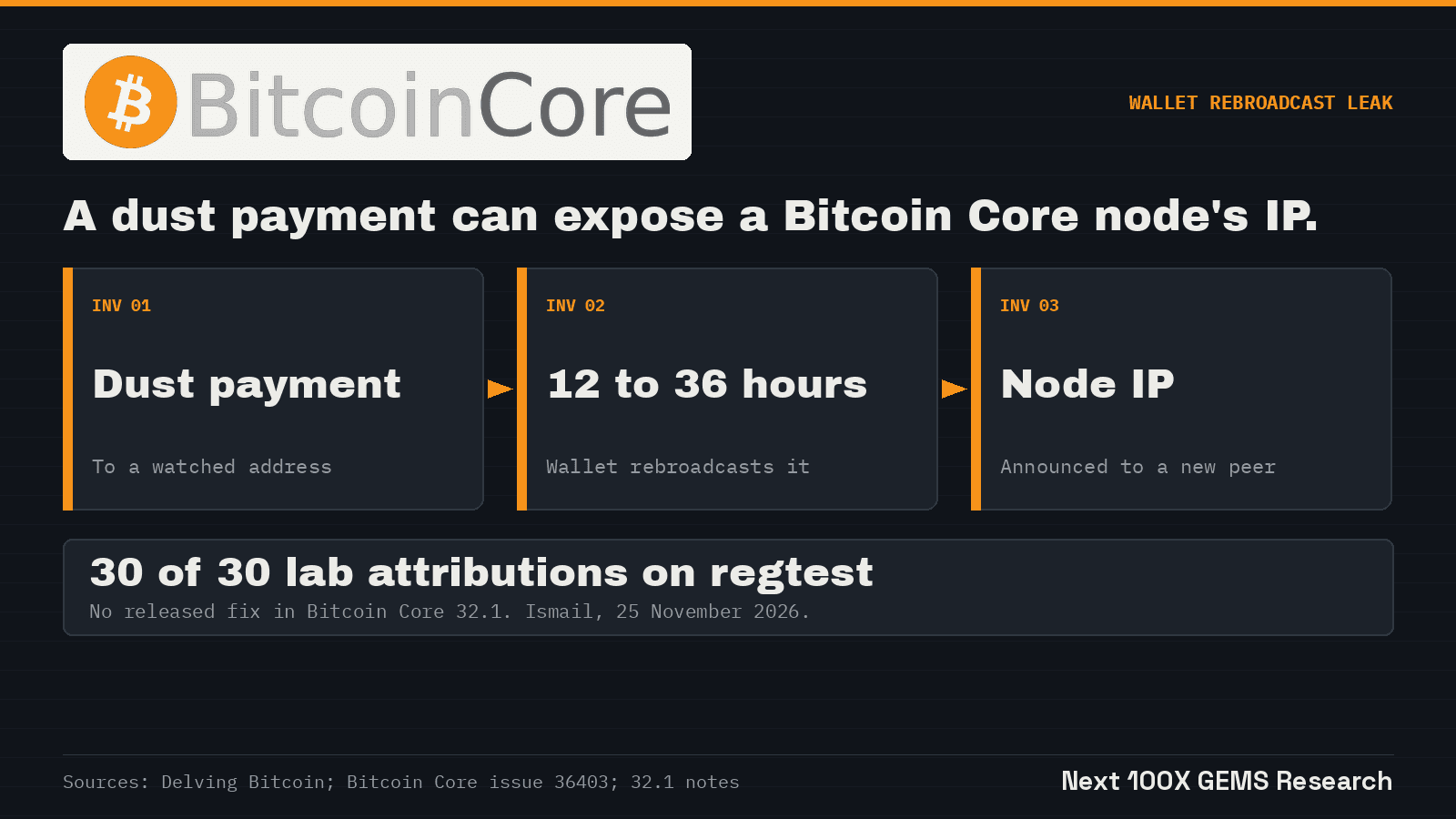
A low-fee payment to an address that a Bitcoin Core wallet is watching can expose the IP address of the node that holds that wallet. Abubakar Sadiq Ismail, a Bitcoin Core contributor, laid out the method in a 25 November 2026 post on Delving Bitcoin. On a regtest laboratory built from stock Bitcoin Core, a freshly connected spy peer tied each planted payment to the correct node in 30 of 30 trials. Nothing in that work was measured on the live Bitcoin network.
How the rebroadcast gives the node away
The leak sits in the wallet, not in ordinary transaction relay. With the default setting of -walletbroadcast=1, a loaded Bitcoin Core wallet periodically resubmits unconfirmed transactions it knows about, whether it sent them or only received them, and announces them to transaction-relay peers. Andrew Chow, writing in issue 36403 on 1 October 2026, described the timer as a uniformly random wait of between 12 and 36 hours since the last rebroadcast. That interval has been the documented cadence since Bitcoin Core 0.21.0, released on 14 January 2021. On the timer, a transaction is also skipped unless the wallet received it more than five minutes before it last saw a new chain tip.
The active method does not wait for the victim's own payment. The attacker sends a small payment, at a fee low enough that it is unlikely to confirm quickly, to an address that has already been used, then waits out the timer. A relay node does not re-announce an old mempool transaction to a newly connected peer. The wallet does. A spy that connects after the first announcement, and has not been told about the payment, sees which candidate re-announces it. That node is running a wallet that tracks the address.
A watch-only wallet is enough. Ismail's write-up is explicit: the membership check is on the script, not on possession of the key, so the hit identifies the node that recognizes the address, which may not be the party that controls the coins. Private broadcast does not close the hole. The first announcement can go out on a private path; the later rebroadcast, he writes, falls back to announcing to all transaction-relay peers. A node that uses Tor or I2P but also keeps clearnet peers will re-announce over clearnet too. Nodes that do not accept inbound connections can still be observed if they dial out to an attacker's listening node.
What the laboratory showed
The 30-of-30 figure is a regtest result, not a mainnet measurement. A hub planted one low-fee payment into each of five target wallets, and a fresh spy connected to each target. That setup was repeated across six trials, for 30 attributions. The targets ran default Core descriptor wallets; Ismail writes that a watch-only wallet would behave the same. The published results table is from a 31.1 run; the write-up also says the attack was verified against the then-current released version, 32.1, and against the development branch. The same table records a control: when the targets were started with -walletbroadcast=0, attribution fell to 0 of 30. A passive observer, watching first announcements only, never attributed a planted payment to the address-controlling node.
Ismail's cost model, dated 25 November 2026, uses the default minimum relay fee of 0.1 sat/vB and a dust-threshold output. He estimates one planted transaction at 309 sat for a P2WPKH output, 346 sat for P2TR, and 569 sat for P2PKH. By our arithmetic from his table, 95 to 96% of that is the dust output itself, which lands in the target's address; the relay fee is 15 to 23 sat.
The proposed fixes, as of 27 November 2026
No released Bitcoin Core version ships a change that closes this leak. On 27 November 2026 we checked the state of the pull requests discussed in Ismail's post and issue 36403. All four were still open. The Bitcoin Core 32.1 release notes, published 27 October 2026, do not mention a wallet-rebroadcast change.
| Change | What it would do | State on 27 Nov 2026 |
|---|---|---|
| PR 36482 (Andrew Chow) | Rebroadcast only a transaction newly added to the node's own mempool | Open |
| PR 36398 (Martin Zumsande) | Rebroadcast only transactions that originate from the wallet | Open |
| PR 36380 (Vasil Dimov) | Add -walletbroadcast=initialonly, so the wallet sends once and does not periodically rebroadcast | Open |
| PR 36481 (Andrew Chow) | Let a user rebroadcast a wallet transaction by hand | Open |
PR 36482 would remove the signal for a planted payment that remains in the victim's mempool, but it would not finish the job. If that transaction is evicted and the wallet later resubmits it, the "newly added" rule would rebroadcast it again. A node with a small mempool can still resubmit and re-announce a payment that other nodes still hold. Zumsande wrote that PR 36482 "only raises the cost of the active attack slightly, it doesn't prevent it," and argued for making rebroadcast of payments that merely pay the wallet opt-in, by combining PR 36398 with PR 36481. Our earlier account of the Bitcoin Core orphan-announcement stall covers a different announcement bug, a node stall rather than a privacy leak.
Does this affect my Bitcoin Core wallet?
It can, if a Bitcoin Core wallet is loaded and rebroadcast is left on, which is the default. Ismail verified the attack against current released Bitcoin Core, version 32.1, and the development branch. Watch-only wallets are included. Software that talks to Core as a backend inherits the behavior if it puts addresses into a Core wallet. Bitcoin Knots is listed alongside Core in Ismail's table, because it uses the same kind of native descriptor wallet with the same default. This leak is not a seed-generation failure of the kind in our COLDCARD seed-generation postmortem. It does not require anyone to reach the machine or the keys, and it has not been measured in the wild.
Until a fix ships, the options are Ismail's mitigation table and Bitcoin Core's documented -walletbroadcast=0, available since version 0.11.0. Setting -walletbroadcast=0 "kills the rebroadcast signal," he writes, and also "disables all wallet broadcasting, including the initial send of your own txs; you must relay them yourself." Restricting the node with -onlynet=onion or -onlynet=i2p "stops clearnet IP exposure even if rebroadcast stays on," but "still links the address to the node's onion/I2P identity; a dual-stack node is not protected." A different clearnet exposure, for mining pool connections, is the subject of our report on Braiins' Stratum V1 hijack advisory.
Sources
- Abubakar Sadiq Ismail, "Exploiting wallet rebroadcast to link addresses to node IPs (and more)", Delving Bitcoin, 25 November 2026
- ismaelsadeeq, core-wallet-rebroadcast-research (README and reports/deanonymization.md)
- ismaelsadeeq, core-wallet-rebroadcast-research, lab/RESULTS.md
- Bitcoin Core issue 36403, Andrew Chow, "Rethinking Transaction Rebroadcasting", 1 October 2026
- Bitcoin Core PR 36482, Andrew Chow, still open as of 27 November 2026
- Bitcoin Core PR 36398, Martin Zumsande, still open as of 27 November 2026
- Bitcoin Core PR 36380, Vasil Dimov, still open as of 27 November 2026
- Bitcoin Core PR 36481, Andrew Chow, still open as of 27 November 2026
- Bitcoin Core 0.21.0 release notes, 14 January 2021 (12 to 36 hour rebroadcast interval)
- Bitcoin Core 0.11.0 release notes, 12 July 2015 (
-walletbroadcast=0) - Bitcoin Core 32.1 release notes, 27 October 2026
Next 100X GEMS Research
The research desk at Next 100X GEMS. Stories name the document they rely on, and a sponsored post is labeled as paid.
How the desk sources stories