Canton's fees beat Ethereum's: what the number actually counts
Canton says its fees topped twice Ethereum's in the 30 days to 17 November. The sum is real, but it counts a voted dollar price paid in burned CC, it comes back as new coins, and it leaves out Canton's biggest institutional users.

Canton Network posted on 19 November that in the 30 days through 17 November its fees were "more than twice the network fees paid on Ethereum." Ethereum users paid $20.22 million in gas and blob fees over those 30 days, according to DefiLlama's daily data. So the claim implies more than about $40 million for Canton over the same window. A figure of about $42.6 million has circulated online. We couldn't confirm it. Canton didn't publish one, CantonScan blocked our checks, and Token Terminal shows no Canton fee figure.
The claim isn't new, and it's plausible. On Alea Research's count, Canton has out-earned Ethereum, Tron and Solana in every quarter of 2026. The trouble is the word "fees." It means something different on each side of the comparison.
The quarter, by Alea's count
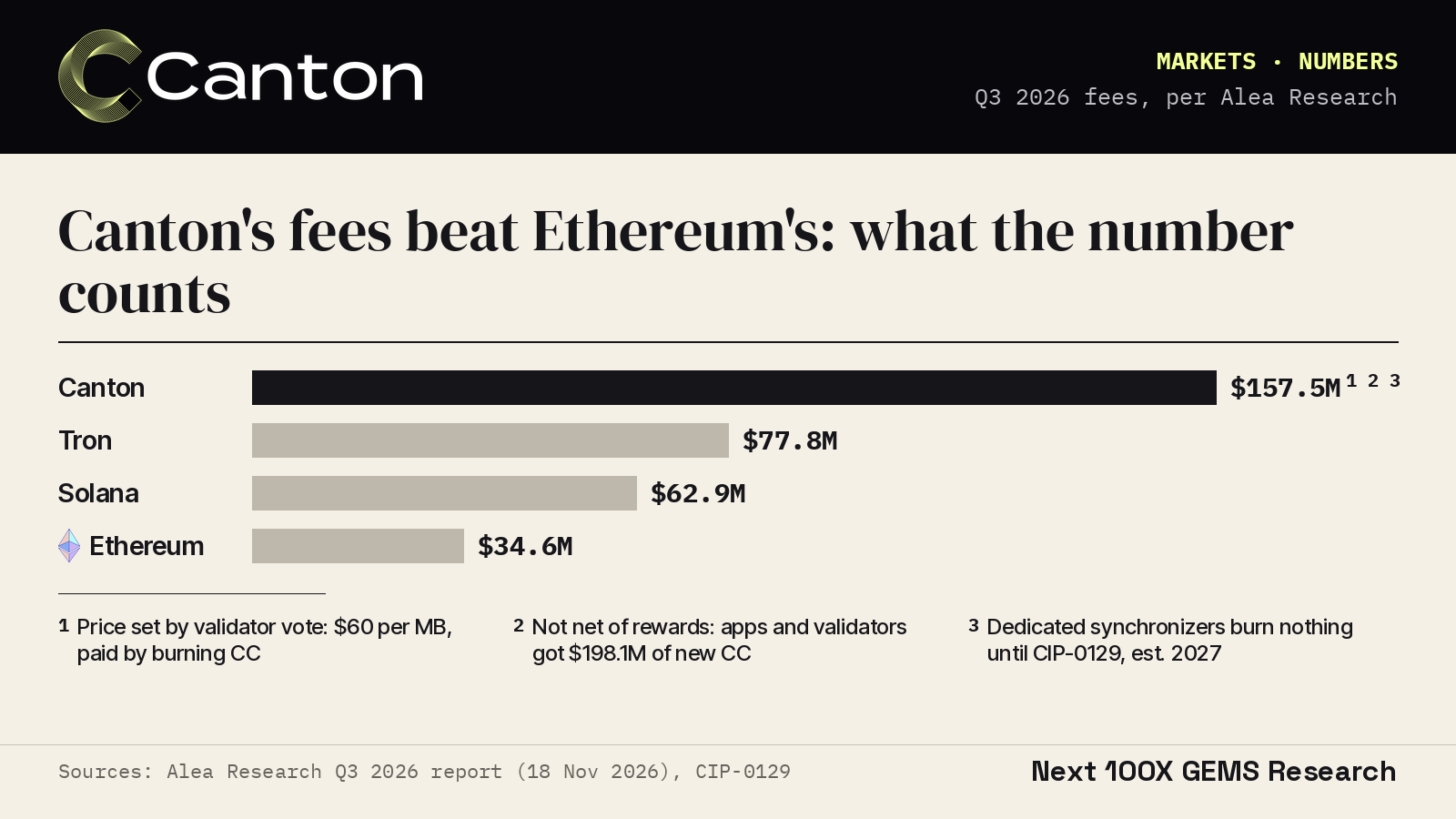
Alea's Q3 2026 report, published 18 November, has the numbers:
| Network | Q3 2026 fees |
|---|---|
| Canton | $157.5M |
| Tron | $77.8M |
| Solana | $62.9M |
| Ethereum | $34.6M |
Ethereum's line checks out. DefiLlama's daily series sums to $34.6 million for July through September. Canton's line is CC burned for traffic, priced in dollars on the day it burned. A lot sits behind those words.
What it leaves out: who sets the price
On Ethereum, the fee is whatever users bid for space in a block. When nobody wants the space, fees fall. Canton doesn't work that way. Traffic above each validator's free allowance costs $60 per megabyte, about a dollar for a median transaction, according to Alea, and CIP-0129 calls it the list price. The 13 nodes that run Canton's Global Synchronizer set that price by vote. Alea found it read $60.0 per MB in all 22 votes from January to November.
So Canton's fee total is traffic times a number its operators chose. That's a legitimate design, and Alea compares it to Hedera, another network with dollar-priced fees and a council of firms. It's still a tariff, not a market price. The payer covers it by burning CC at the network's own rate. The dollar charge stays fixed while the number of coins burned moves around.
What it leaves out: where the burn goes
Ethereum burns its base fee and that ETH is gone. Canton burns CC for traffic, then mints new CC about every ten minutes and pays it to apps, validators and Super Validators. Some of those rewards scale with the burn each app reports.
Alea's Q3 report puts it plainly: "Canton's fees aren't net of rewards." In Q3, apps and validators earned $198.1 million of new CC against $157.5 million burned. That's $40.6 million more than the network burned. Counting Super Validators, round mints added $229.4 million of CC against the same burn. A cap on app rewards took effect on 5 November and is meant to narrow that gap.
Supply still grows. Decrypt, citing CantonScan, reported on 14 November that the network was burning roughly 80% as much CC each day as it minted. Alea's own Q3 figure was 68.9% of round mints. Either way, the fee line on a dashboard is only half of the ledger.
What it leaves out: the biggest customers
Canton's pitch is regulated finance, and much of that business runs on dedicated synchronizers, which institutions operate for their own traffic. Traffic on those "doesn't burn anything," says CIP-0129, the universal burn proposal that Super Validators approved on 23 October. It has been "paid for through license fees to Digital Asset," Canton's creator.
Universal burn would make every production synchronizer burn CC at the list price, with volume discounts later. Its authors put phase one at Q1 2027 and phase two at Q3 2027, and call those "ambitious estimates," not deadlines. So the fee number leaves out the institutional traffic Canton is best known for, and counts the public lane mostly used by trading venues and wallets. Alea says Temple, Kora and Cantex alone paid 56.5% of Q3's burn.
Who's counting
The data trail runs close to the network. The claim came from Canton's own account. CantonScan, the explorer behind most burn figures, is built by Proof Group, which sits on the network as a Super Validator under CIP-0034. That's the role that votes on the $60 price and earns rewards. Alea says its report "was not paid for or commissioned," and that team members may have positions in the tokens it covers. We found no paid tie between Token Terminal and Canton. CCTools, a third-party Canton directory, says Token Terminal has published metrics for the Temple exchange since 19 August.
None of that makes the numbers wrong. It means they come from people with a stake in them.
The verdict
Canton does collect more for its traffic than Ethereum does, but whether that means it beats Ethereum on fees depends on who sets the price and who's left out of the count.
Sources
- Canton Network on X, 19 Nov 2026 (as published by Tree News): https://tree.news/news/fees-follow-usage-network-fees-on-canton-are-paid-by-burning-cc-so-the-total-g4taw7g0isjw
- DefiLlama, Ethereum daily fees API (read 22 Nov 2026): https://api.llama.fi/summary/fees/ethereum?dataType=dailyFees
- Alea Research, "Canton: Q3 2026", 18 Nov 2026: https://alearesearch.io/reports/benchmark/canton-q3-2026
- Alea Research, "Canton's burn goes universal", 2 Nov 2026: https://alearesearch.io/newsletters/canton-universal-burn
- CIP-0129, Universal Burn and Synchronizer Pricing (approved 23 Oct 2026): https://github.com/canton-foundation/cips/blob/main/cip-0129/cip-0129.md
- CIP-0084, $/MB price tuning: https://github.com/canton-foundation/cips/blob/main/cip-0084/cip-0084.md
- CIP-0034, Proof Group as Super Validator: https://github.com/canton-foundation/cips/tree/main/cip-0034
- Canton Network, Proof Group launches CantonScan, 4 Jun 2025: https://www.canton.network/canton-network-press-releases/proof-group-launches-first-ever-canton-block-explorer
- Decrypt, "What Is Canton Network?", 14 Nov 2026: https://decrypt.co/383183/what-is-canton-network-the-privacy-blockchain-built-for-wall-street
- Token Terminal, Canton Network page: https://tokenterminal.com/explorer/projects/cantonnetwork
- CCTools ecosystem listing, Token Terminal: https://cctools.network/ecosystem/token-terminal
Next 100X GEMS Research
A crypto community active since 2021, focused on helping newcomers spot scams and understand the market.
How we work