
Chainflip's $4.86M vault drain: how a valid signature emptied the Ethereum vault, and the nonce that gave it away
Chainflip's Ethereum vault was handed a correctly signed order on 21 November and paid out everything it held. Three clues on-chain point to a suspected key compromise, and Chainflip now says 122.86 BTC went too.

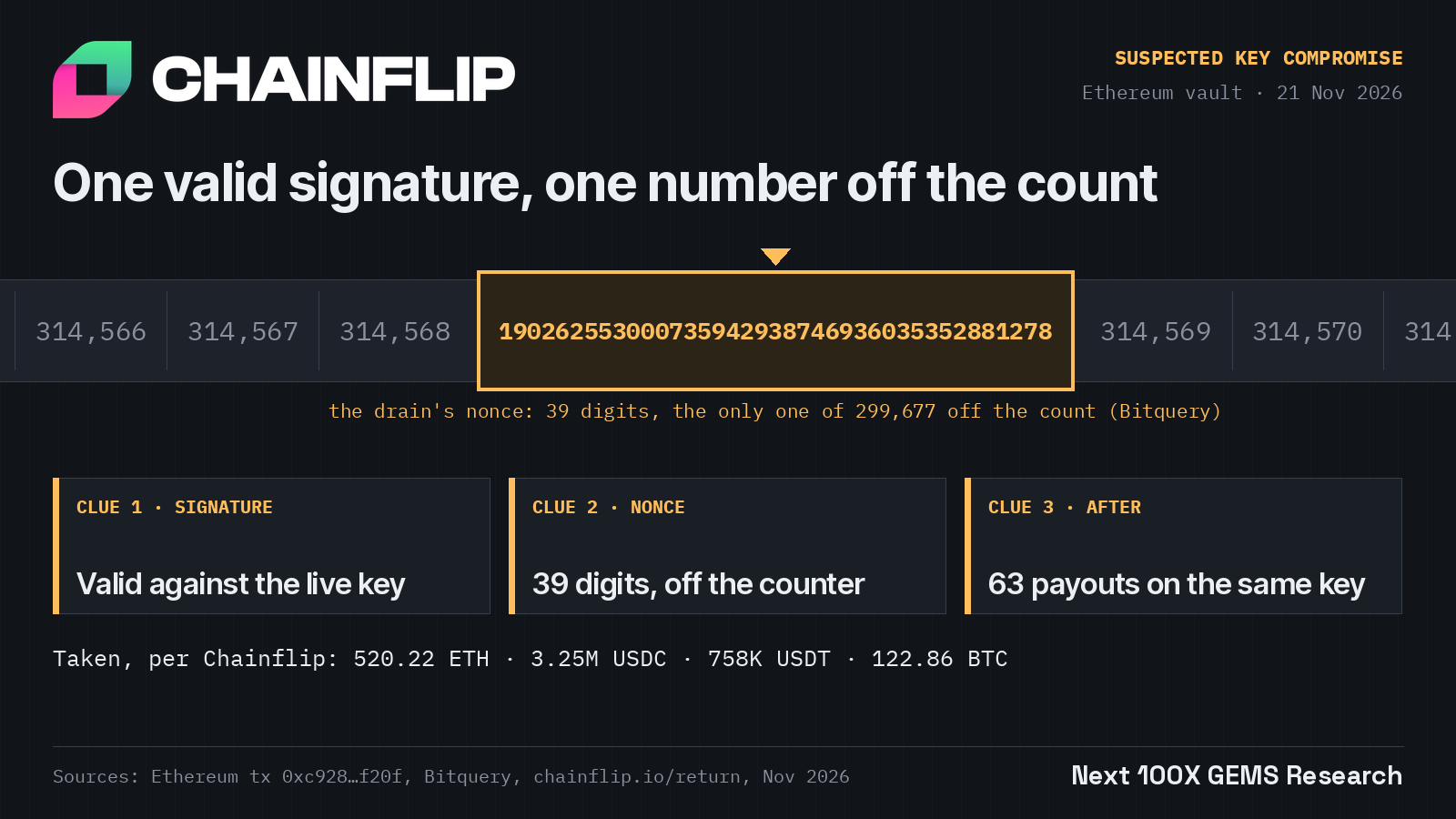
On 21 November 2026, Chainflip's Ethereum vault paid out every unit of ETH, USDC and USDT it held: 520.22 ETH, about 3.25 million USDC and about 758,000 USDT, worth roughly $4.86 million according to Defimon and Bitquery. It did so in one transaction, and its signature check passed. The vault is built to pay any order that carries a valid signature from the network's shared key, and this order carried one. Security firms, and The Block in its headline, call it a suspected key compromise. Chainflip says it has "identified the mechanism of key exposure" but hasn't said what it is. Later the same day it added 122.86 BTC to the list of what was taken.
So the open question is less how the contract was tricked than who was able to sign in the network's name.
Clue one: the signature
Chainflip swaps native coins between chains and keeps them in vaults on each chain. Up to 150 validators run the network, and no single one is meant to be able to move vault funds. They use a threshold scheme called FROST: each validator holds a share of one aggregate key, and normally at least 100 of them must take part to produce a signature. The key is replaced every three days. The last regular rotation before the drain was on 18 November, The Block reported.
The drain arrived through the vault's transferBatch function, which lets one signature cover several payouts. We read it on-chain. The successful receipt logs the key contract accepting the request and the token transfers. Defimon, Decurity's alert service, said the Schnorr signature verified against the live aggregate key. The three payments went to a fresh wallet. The wallet that sent the order had received its gas money from Tornado Cash a minute earlier, Bitquery found. Within about ten minutes the stablecoins had been swapped to ETH and roughly 2,909 ETH sat in Tornado Cash, per Bitquery and AMLBot.
A valid signature passes the check for the right public key. It doesn't tell you the network meant to use it.
Clue two: the nonce
Every signed payout carries a nonce, a number the key contract records so that an old order can't be replayed. On Ethereum, Chainflip draws these from a running count. Bitquery went through all 299,677 signatures the contract has accepted since 2023. Every one sits on the count except one. The count stood at 314,568 just before the drain and 314,569 just after. The drain's nonce, which we decoded from the transaction, was 190262553000735942938746936035352881278. That's 39 digits.
The contract only asks whether a nonce is new, and that one was. But Chainflip's own signing process would have handed out the next number on the counter. A number from nowhere suggests the order was signed outside that process. Bitquery lists what could explain it: a stolen key, key shares taken from enough validators, or a flaw that lets a bad signature pass. On-chain, all three look the same.
If "nonce" rings a bell from our Lighter piece, this is a different thing: there a reused secret signing nonce leaked a key, while here the nonce is a public counter against replays.
Clue three: 63 payouts under the same key
For almost two hours after the drain, the network behaved as if nothing had happened. Validators kept signing ordinary payouts with the same key as deposits came in, 63 of them, each on the count, Bitquery found. Then the vault moved to a new key, about 13 hours before the next rotation was due. Bitquery saw no Ethereum signatures after that switch. Chainflip put the protocol into full safe mode, disabling deposits, withdrawals, swaps and quoting, it said on X.
The ordinary signing process seems to have run on beside the drain. In Bitquery's reading, the anomalous order came from outside that process, rather than replacing it. That is evidence about how the order arrived, not proof of how signing material was obtained.
The bitcoin, and the bounty
Chainflip's own account came later on 21 November, in a message to the attacker at chainflip.io/return. It says 122.86137042 BTC was taken as well as the Ethereum assets. It says it traced the preparation: Tornado Cash funding on 11 November, a FLIP purchase, a validator account registered on 20 November, and the server behind it. It says it has identifying information and has reported the theft to law enforcement.
The offer is 10%. Chainflip asks for 110.57523337 BTC and 2,618.1 ETH, the return amounts specified on its page, and says that if both arrive by 23 November it will treat this as a white-hat recovery and withdraw its complaints. The page still carried that offer when we checked on 22 November.
The Bitcoin record shows the 122.86137042 BTC that Chainflip identifies as stolen passing through an intermediate address and settling, less transaction fees, at bc1qm777…v4g6. It hadn't moved when we checked on 22 November, and Chainflip's on-chain note, "return 90%, keep 10%," sits at the same address.
A different failure from September
Chainflip has lost money once before this autumn. On 12 September 2026, an attacker took 736,442.17 USDT from its Tron vault. Chainflip's post-mortem says the attacker took a transaction validators had already signed and attached a memo of their own. Chainflip's systems read the memo as a failed swap and refunded it, so six withdrawals were paid twice. That was a bug in how Chainflip read one chain, and it was patched. Validators then voted to use surplus funds to make the affected liquidity providers whole. In September, real signatures were misused. In November, the nonce points to a signature made outside the usual process.
What's still unknown
Chainflip hasn't published the mechanism of key exposure. It hasn't said whether a full key leaked or enough shares were gathered, or how an account registered on 20 November fits a key last rotated on 18 November. It hasn't said whether users or liquidity providers will be repaid, or when safe mode ends. The evidence reviewed here doesn't establish who signed the order. The one thing the chain does show clearly is the one number that didn't fit.
Sources
- Chainflip Labs, message at chainflip.io/return (read 22 Nov 2026): https://chainflip.io/return
- Chainflip, FROST documentation: https://docs.chainflip.io/protocol/frost-signature-scheme
- Chainflip on X, safe mode statement, 21 Nov 2026 (quoted by The Block and CoinDesk): https://x.com/Chainflip
- Bitquery, "Chainflip hack: one rogue signature emptied its Ethereum Vault of $4.86M", 21 Nov 2026: https://bitquery.io/investigations/chainflip-hack
- Etherscan, drain transaction: https://etherscan.io/tx/0xc928950f79b4e4697af674310d1f3a08c2659adc4d60e719f3af90ab023ff20f
- mempool.space, BTC transfer: https://mempool.space/tx/ac38a5aea1ed81b84307a3709f502abd4c4d3af5502493f883c6d19624fd2cb4
- mempool.space, Chainflip on-chain message: https://mempool.space/tx/0f75dbd50f247d4d29ffb5d19dae9907f0322f9ef504720b7e27d2453624f004
- The Block, 21 Nov 2026: https://www.theblock.co/news/defi/2026-11-21-chainflips-flip-drops-34-after-attacker-drains-4-86-million-from-vault-with-suspected-key-compromise-444804
- CoinDesk, 21 Nov 2026: https://www.coindesk.com/business/2026/11/21/cross-chain-protocol-chainflip-s-flip-tanks-30-after-suspected-usd4-86-million-vault-drain
- Chainflip blog, Tron USDT incident report, 13 Sep 2026: https://chainflip.io/blog/tron-usdt-exploit-what-happened-and-what-happens-next
- Chainflip blog, "Getting Chainflip back up and running", 15 Sep 2026: https://chainflip.io/blog/getting-chainflip-back-up-and-running
- Chainflip blog, "Proposal 008 Passed: Making Tron USDT LPs Whole", 18 Sep 2026: https://chainflip.io/blog/proposal-008-passed-making-tron-usdt-lps-whole
Next 100X GEMS Research
A crypto community active since 2021, focused on helping newcomers spot scams and understand the market.
How we work